Pages

Friday, April 29, 2016

The Divide over Islam and National Laws in the Muslim World


By Jacob Poushter
April 27, 2016
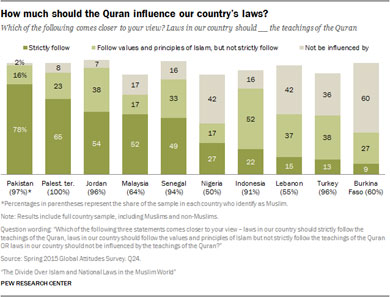
As strife in the Middle East continues to make headlines, from the militant group ISIS to Syrian refugees, the Muslim world is sharply divided on what the relationship should be between the tenets of Islam and the laws of governments. Across 10 countries with significant Muslim populations surveyed by Pew Research Centre in 2015, there is a striking difference in the extent to which people think the Quran should influence their nation’s laws.


In Pakistan, the Palestinian territories, Jordan, Malaysia and Senegal, roughly half or more of the full population says that laws in their country should strictly follow the teachings of the Quran. By contrast, in Burkina Faso, Turkey, Lebanon and Indonesia, less than a quarter agree. And in many of these countries where non-Muslims make up a significant portion of the population, there are strong disagreements between major religious groups on this issue.
For example, a 42% plurality of Nigerians think laws should not be influenced by the Quran, while 27% think laws should strictly follow the teachings of the Quran. However, among Nigerian Muslims, 52% say national laws should conform to Islamic law, compared with only 2% among Nigerian Christians.
These are the main findings of a recent Pew Research Center survey of 10,194 respondents conducted in 10 countries with significant Muslim populations from April 5 to May 21, 2015. Unless otherwise noted, results are for national populations, including non-Muslims. The percentage of the population that is Muslim in each of these countries ranges from almost all in the Palestinian territories and Pakistan to about half in Nigeria. The survey includes four of the 10 countries with the largest Muslim populations in the world (Indonesia, Pakistan, Nigeria and Turkey).
Where People Say Their National Laws Should Strictly Follow the Quran
Half or more in four of the 10 countries surveyed say that laws in their countries should strictly follow the teachings of the Quran. This opinion is especially prevalent in Pakistan (78%), one of only five declared Islamic Republics in the world, and the Palestinian territories (65%). Support for strict adherence has grown in the Palestinian territories. In 2011, only 36% of Palestinians said their laws should strictly follow the Quran.
In Jordan, which is a constitutional monarchy, 54% say their laws should strictly follow the Quran. Another 38% say Jordan’s laws should follow the values and principles of Islam but not strictly follow the Quran. Just 7% believe that laws should not be influenced by the Islamic holy book. Since 2012, there has been an 18-percentage-point decline in the number of Jordanians saying the Quran should be strictly followed in making national laws.
Roughly half of Malaysians (52%) favour strict adherence when it comes to national laws; fully 78% of Muslim Malays hold this view, but only 5% of Buddhist Malays agree. Instead, 38% of the Buddhist minority in Malaysia prefers that laws not follow the Quran, though a similar percentage (37%) does not offer an opinion.
Senegalese are split on the issue: 49% say that laws should closely abide by the Quran, while an equal percentage says that laws should either not strictly follow (33%) or not be influenced by the Quran (16%).
In Nigeria, only 27% among the general population believe that laws should closely follow the Quran, with 17% saying laws should be guided by Islamic principles and 42% saying the Quran should not influence laws at all. Not surprisingly, there is a sharp divide on this question between Nigerian Muslims and Christians. Around half of Nigerian Muslims (52%) prefer the strict interpretation of the Quran for the country’s laws, while 64% of Nigerian Christians prefer the Quran have no influence.
Since 2013, the percentage of Nigerians who say that national laws should be shaped strictly by the Quran is up 8 percentage points. The increase in this sentiment comes entirely from the Muslim population. Views among Christians in Nigeria have not changed since 2013.
Where People Say National Laws Should Adhere Less Strictly To the Quran
People in Indonesia, Lebanon, Turkey and Burkina Faso are more secular in their orientation. Roughly two-thirds or more in each of these countries prefer that laws either be only influenced by the Quran (and not strictly follow its teachings) or that the Quran be left out of lawmaking altogether. In the case of Lebanon and Burkina Faso, this is due, at least in part, to the religious divides within those countries.
A majority of Lebanese Christians (59%) say the Quran should not influence their nation’s laws. Lebanese Sunni are divided between saying that the Quran should not influence political laws (37%) and that laws should simply reflect Islamic values (34%). Among Lebanese Shia, 56% say that laws should follow Islamic principles, but not strictly.
Only a quarter of Lebanese Muslims say that laws should strictly follow the Quran, perhaps a reflection of the country’s diverse ethnic and religious makeup and its laws that give each religious group a say in national politics. Half of young Lebanese (18- to 29-year-olds) say that laws should not be influenced by the Quran, compared with 36% who say this among Lebanese 50 and older.
In Turkey, which was founded as a secular democracy in 1923, 36% say that laws should not be influenced by the Quran, compared with 27% who said this in 2012. Opinions on this issue in Turkey are driven, in part, by devoutness to Islam and age. Muslims in Turkey who pray five times per day or more are far more likely to say laws should strictly follow the Quran (32%) than are those who pray fewer than five times per day (9%). And generally, younger people in Turkey are less likely to say that laws should strictly follow the Quran.
An overwhelming majority in Burkina Faso says that the country’s laws should not be influenced by the Quran (60%) or should only follow the values and principles of Islam (27%). Christians in Burkina Faso are far more likely to say laws should not be influenced by the tenets of Islam (77%) than are Muslims (50%).
Generally, More-Educated People Say Laws Should Not Follow Quran
In six of the 10 countries surveyed, people with a secondary education or more are more likely to say that national laws should not be influenced by the Quran, compared with those who have less than a secondary education. For example, 48% of Nigerians with a secondary education or more say that the Quran should not influence laws, versus 29% among those with less than a secondary education. In this respect, more educated people in these countries have more secular views on this issue.
Source: pewglobal.org/2016/04/27/the-divide-over-islam-and-national-laws-in-the-muslim-world/
- See more at: http://newageislam.com/islamic-society/jacob-poushter/the-divide-over-islam-and-national-laws-in-the-muslim-world/d/107142#sthash.wI0u77oU.dpuf

The Madrasa Series: Blaming Islamic Schools for Bad Muslim Education Is As Silly As Upgrading Them - Part III


By Yasmin M Khan
Feb 24, 2016
In the debate over the modernisation of madrasas, a question that refuses to go away is whether these institutions are relevant at all in the 21st century. Can madrasas be reformed by tinkering with a few courses or installing a few computers? Do they have the materials and intellectual resources – and, most important, cultural temperament – to prepare their students for the demands of a highly competitive modern world?
The answer is complicated, according to Muslim scholars and observers of madrasas; they dismiss attempts at such a binary approach to addressing the question. Moin Qazi, an academic and noted writer on Islam, believes that madrasas are unfairly portrayed. The majority of these institutions, according to him, “actually present an opportunity, not a threat”.
“For a poor Muslim child in a village, it may be his only path to literacy. For many orphans and the rural poor, madrasas provide essential social services: education and lodging for children who otherwise could well find themselves the victims of forced labour, sex trafficking, or other abuse… For parents mired in poverty and forced to work long hours, madrasas serve a vital role in ensuring their children are supervised, fed, and taught to read and write,” he wrote in a widely published article.
Even critics of madrasas caution against taking extreme positions and favour a more nuanced approach. Sunil Raman, a former BBC correspondent, and a frequent contributor to this website, who has studied the issue in some depth, is no fan of madrasas. But he is even more critical about the successive governments' confused response to how to drag them into the modern world. And he is right. The process of modernisation, as he reminds us, started not under Manmohan Singh but way back in 1992 under PV Narasimha Rao as a gesture towards the Muslims to placate them after the demolition of Babri Masjid.
“Over two decades later and crores of rupees being spent, the government appears to be tackling more or less same issues that existed in the 1990s,” he wrote recently.
He is not the only one who is extremely sceptical about the modernisation process. Critics don't have a quarrel with introducing modern subjects and computerisation but with the idea that this is an answer to the problem of Muslim education. Primarily, madrasas are seminaries meant to impart religious education and that's what they are best at doing. Their primary function is to produce Islamic scholars and imams, not doctors and engineers.
“The focus should be on reforming their religious curriculum and helping madrasas with extra resources so that they can hire better teachers and improve their infrastructure. That will be a better way of increasing their relevance,” said Sami Ullah, who studied at a madrasa and is now enrolled in an Islamic Studies course at Jamia Millia Islamia, Delhi.
Ultimately, he said, he wants to go abroad for higher Islamic studies. “My dream is to be able to study at Al Azhar University [in Cairo] but let's see,” he said. About his madrasa experience, Ullah was clear as to the purpose it served: clarify the tenets of Sharia. "For me it was okay because my need was very basic but their curriculum for advanced courses is extremely limited and offers very few career opportunities. So, there’s a problem there,” he said. He was, however, of the opinion that madrasas aren’t “an oddity”. “We certainly need madrasas, otherwise where will people like me go? Around the world, there are some great madrasas and there is no reason why we can’t have world-class madrasas,” he said.
But the question remains: what does madrasa education offers to its graduates in terms of job prospects? What do they do for a living after they pass out of a madrasa? Gagandeep Kaur, a Delhi-based journalist and researcher, has found that their curriculum is so limited that most universities don’t recognise madrasa education, which means that entry into higher education is barred for students of these institutions – in Uttar Pradesh, they are required to pass a special examination conducted by the state to qualify for a place in a regular college or university. She has written about this at length on Contributoria.
As for job opportunities, a madrasa graduate can aspire to be either a “Maulana” (a teacher) or an imam at a mosque. Neither job pays enough for a decent living. “Most of the madrasas are not equipped to teach students how to live in modern society,” Ghulam Rasool Dehlvi, Islamic scholar and adviser with Jamia Hazrat Nizamuddin Aulia Madrasa, has told Kaur.
This is a view echoed by S Irfan Habib, historian and Islamic scholar. In his interview to Kaur, Habib has said: “When you talk of madrassas...the way they are run is not relevant for the mainstream employment opportunities as the scope and curriculum is very limited.”
Kaur reports that there are some progressive madrasas. Madrasa Taleem-ul-Quran, run by an independent Islamic educational charity, the Haji Langa Trust in RK Puram, south Delhi, is one such. It has attempted to make its curriculum more relevant by combining traditional teaching with market-friendly courses. Rather than having stand-alone courses in modern education, these madrasas have integrated them with the existing syllabus, which means students who already learn Arabic and Urdu are now required to learn English as well.
This, it is claimed, has improved students’ chances of landing a job in the Middle East or in Indian companies that do business with Arab countries which need people who can communicate with their Arabic-speaking clients or business partners. I met Mushtaq Ansari who has become a freelance Arabic-English interpreter. He works for several companies and earns more money in a month than the average university graduate. He has had no formal schooling and learned both Arabic and English at a madrasa on the strength of which he obtained a modest job in an Arab mission. That, he said, gave him an “opportunity” to improve his Arabic and learned to speak it. “A colleague recommended me to a company which was looking for a part-time interpreter. While working for them I found other part-time assignments, and I am happy doing what I am doing,” he said. Ansari’s case is relevant to the debate on the usefulness and relevance of madrasas. But success stories like these are few and far between. For the overwhelming majority, madrasa education remains a dead-end and irrelevant.
Related Articles:
Source: firstpost.com/india/the-madrassa-series-blaming-islamic-schools-for-poorly-educated-muslims-is-as-silly-as-modernising-them-2640306.html
- See more at: http://newageislam.com/islamic-society/yasmin-m-khan/the-madrasa-series--blaming-islamic-schools-for-bad-muslim-education-is-as-silly-as-upgrading-them---part-iii/d/107141#sthash.8Rvh1Bsi.dpuf

Najaf, Karbala and Baghdad: The Exalted Cities


By Sadia Dehlvi
April 23, 2016


Shryan of Hussain|Imam Hussain in Karbala|Sub Kay Imam Hussain|Sardar Hussain Of Jannat|
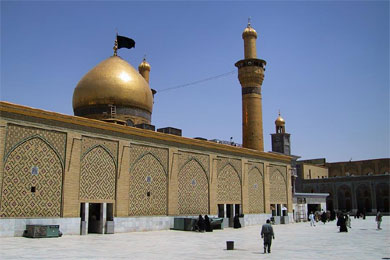
Recently, I journeyed to Iraq, visiting Najaf, Karbala and Baghdad on an invitation from the authorities of the holy shrine of Imam Hussain in Karbala. I thought it as a gift from Imam Ali, lovingly called Maula Ali, and his son Imam Hussain — both whom I love deeply. Aga Sultan Murthaza, an educationist from Bangalore and engaged in humanitarian work in Iraq helped organise this media delegation. He received us at Najaf International Airport, and bought black chadors for women delegates to cover themselves from head to toe, mandatory in the sacred cities of Najaf and Karbala. We stayed at a beautiful, comfortable and spacious complex in Karbala, built to house millions of pilgrims that come throughout the year. Najaf houses the exquisite mausoleum of Imam Ali, Prophet Muhammad’s cousin and son-in-law.
 The Prophet famously said, ‘I am the gate of knowledge and Ali is its door’. Tears flowed as I stood at this door at Najaf, after decades of nurturing the desire to kiss the threshold of Imam Ali. Born inside the precincts of the Kaaba in Mecca, the Prophet named him Ali, meaning the ‘the exalted one’. It is believed that the Prophet transferred his esoteric knowledge to Imam Ali, making him the fountainhead and Imam of the Auliya, friends of Allah, now called Sufis. Maula Ali remains the vital link in spiritual lineages that connect Sufi orders to the Prophet and eventually to God.
Imam Hussain’s mausoleum complex in Karbala is one of the finest examples of Islamic architecture. Growing up observing the martyrdom of Imam Hussain in the month of Muharram and listening to Sozkhani and Noha — eulogies to Imam Hussain, I became overwhelmed with both grief and joy on touching the trellis of his mausoleum. I sat in the women’s area, trying to absorb the benevolence that seemed to fill the space. In stylised Arabic calligraphy, Prophet Muhammad’s words adorn the walls of the shrine, ‘I am from Hussain and Hussain is from me’.
At night, the whole area glitters in a golden hue; large crowds of men, women and children from different parts of the world fill the shrine complex, pathways and bazaars. Catering to the pilgrims, rows of shops sell food, toys, prayer beads and prayer mats, flags and other memorabilia with images of Imam Hussain and Imam Ali.
 It’s a heady mixture of celebration, devotion and grief. Chants of Ya Hussain and Ya Ali fill the air. These invocations reach a pinnacle when bodies of those slain battling the ISIS are brought to these shrines, throughout the day and night. Karbala represents the eternal clash between truth and falsehood. Imam Hussain was martyred on this battleground in 680 CE at the hands of the tyrannical Yazid, the Ummayad ruler.
Yazid had declared himself the head of the Islamic caliphate and ordered Imam Hussain to give allegiance to him. Imam Hussain fought with just 72 companions against a huge well-equipped army. After they were martyred, the Prophet’s beloved grandson stood alone, suffering a volley of arrows but fighting bravely till his head was severed from his body, while he prostrated in prayer. The mausoleum stands at the place of his martyrdom. The camps where women of Imam Hussain’s family looked on helplessly as their men fell are marked by exquisite memorials that are popular places for collective mourning and prayer. Imam Hussain preferred to die, rather than legitimise oppression and injustice in the name of Islam. His sacrifice and courage against the face of evil, is what continues to inspire the Iraqis to fight the ISIS. Two years ago, Ayotallah Ali Sistani called on Iraqi citizenry to join Hashd, the civilian resistance force. Since then, over a Lakh volunteers have joined ranks to fight ISIS, playing a key role in reclaiming key cities. This call, made from Najaf, echoes with symbolism, for it was here that a group of Muslims disagreed with Imam Ali. They killed him with a poisoned sword and came to known as Kharijites, people out of Islam. Scholars liken terrorists to these early Kharijites, who were radicals pronouncing those who did not follow their version of Islam as apostates. The military commanders we met seemed eager to dispel the perception that the war in Iraq is between Shias and Sunnis. They inform that Sunnis make up a large part of their ranks, and that all Iraqis are united against their fight against terrorism. The roads from Najaf to the airport and to Karbala are littered with lampposts, carrying pictures and eulogies of slain Iraqi fighters.
In these troubled times, there is no family that remains unaffected. In the refugee camps, both men and women told horror stories of their escape from ISIS strongholds, children of missing school, women of the lack of money, water and food, many of their men dead or at war. Yet, they were gentle and hospitable, insisting that we share their table.
Some even enthusiastically talked about their favourite Indian films and Shahrukh Khan.
Baghdad is a different experience altogether. It’s a bustling city with chaotic traffic, jean-clad women, military check posts and armoured military vehicles zipping past. I visited the mausoleum of Shaykh Abdul Qadir Jilani, the great Sufi Master of the 12th century; another dream that came true. We couldn’t stay long enough, as Baghdad is not as safe as Najaf and Karbala. We passed the walls of Saddam Hussain’s palace, now in ruins. We drove by the Euphrates River, the waters of which were denied to Imam Hussain during the Karbala battle. Iraq is called ‘the cradle of civilisation’. Visiting these legendary cities brings alive both ancient and contemporary histories
Source: speakingtree.in/article/exalted-cities
- See more at: http://newageislam.com/islamic-culture/sadia-dehlvi/najaf,-karbala-and-baghdad--the-exalted-cities/d/107140#sthash.QOoYuj6J.dpuf

We Need to Bridge the Divide between Jews and Muslims Now More Than Ever


By Akbar Ahmed
04/28/2016


Pacific Press Via Getty Images
Why would a senior rabbi and a Muslim scholar engage in dialogue at this moment in history, at a time when relations between Jews and Muslims have reached dangerous levels of tension around the globe?
Barely a day goes by when we do not read of some incendiary terrorist attack by a Muslim claiming to act in the name of Islam. Sometimes the victims are fellow Muslims, and at other times, the acts of violence are perpetrated against Jews or Christians. Muslims have attacked Jewish supermarkets, museums, synagogues and schools, in part causing more and more Jews to leave France and other European countries, where their roots run deep, for Israel for fear of their safety. These acts are neither sanctioned by Islam nor are motivated by the nobler aspirations of humanity.
How we treat interfaith relations today will have significant implications for our world’s future.
The picture for Muslims is equally dire. Across North Africa, the Middle East, in Afghanistan and Pakistan, the Muslim world is in turmoil. Our hearts break when we contemplate the hundreds of schoolgirls kidnapped by Boko Haram in Africa and the nearly 150 — mostly children — killed at the Army Public School in Peshawar. Equally shocking is the frequent news of violence against Christians or other minorities in countries like Egypt and Pakistan.
Muslim on Muslim violence is reaching new heights, with sectarian, tribal and political conflicts tearing the Muslim world apart. In the vacuum of authority, militant groups like the self-proclaimed Islamic State appear to rampage almost unchecked.
The Middle East continues to be a powder keg for Jewish-Muslim relations, as the Israeli-Palestinian conflict continues to simmer, with knifings of innocent civilians the preferred means of attack du jour. With little hope of resolution, tensions are reaching a boiling point. It is in the interest not only of Jews and Muslims, but also the world at large to find a peaceful and just solution as soon as possible.
The Syrian conflict also drags on with no solution in sight. Perhaps partially in response to these acts and the headlines, coupled with a lack of understanding of Islam and its internal divisions, and not knowing how to respond, Islamophobia is reaching a fevered pitch in European and American politics. There is open talk of monitoring Muslim neighbourhoods, “interning” the community and banning all Muslim entry to the United States.
It is with all this as a backdrop that we believe it is especially important, precisely when our faith communities are at the tipping point, to join together and reach out to each other.
As our experiences here in the Washington region and abroad demonstrate, interfaith dialogue at all levels can have a huge impact. Recently at American University in Washington, we co-chaired a Jewish-Muslim dialogue luncheon featuring six of the region’s top rabbis and several leading Muslim figures from the area, including Acting U.S. Special Envoy to the Organization of Islamic Cooperation Arsalan Suleman. Each community was represented by a diverse array of voices and perspectives, and this off-the-record session gave everyone an opportunity to explore their questions and perceptions about the other faith. Many entered the meeting sceptical of engaging the other community, and disagreements emerged which had to be settled, but by the end, participants expressed a strong commitment to remain in touch and contribute to interfaith initiatives in each other’s houses of worship. Interfaith dialogue in fact builds bridges.
Consider this dialogue luncheon in the broader American context. In American politics, we are witnessing a startling escalation of religious, ethnic and racial discrimination and divisiveness that is quickly racing down a slippery slope. Many of the tensions are fed by misimpressions and emerge because each side does not know or encounter the other.
In the current presidential campaign, first, Mexicans were targeted as being rapists and drug lords, and then Muslims were targeted for being terrorists. As if anti-minority sentiments could not get stronger, recently, supporters of leading Republican candidate Donald Trump have even been heard telling Black Lives Matter protesters to “go back to Africa.” Something must be done to counter this dangerous rhetoric.
As we watch the rise of both Islamophobia and anti-Semitism across the U.S. and around the globe, we must all bear in mind the foreboding poetry of German pastor and anti-Nazi dissident Martin Niemöller:
First they came for the Socialists, and I did not speak out —
Because I was not a Socialist.
Then they came for the Trade Unionists, and I did not speak out —
Because I was not a Trade Unionist.
Then they came for the Jews, and I did not speak out —
Because I was not a Jew.
Then they came for me — and there was no one left to speak for me.

We are both grandfathers. As such, we have to be thinking not of ourselves and our lives, but rather about our children and grandchildren. What sort of world will they inherit by the end of this century? Will it be a world facing mass warfare, climate catastrophe, crippling inequality and other social disasters? Or will it be a world where all of our faiths can live in harmony with one another and where faith leaders will lead the way so that humanity can come together to solve our greatest global challenges? How we treat interfaith relations today will have significant implications for our world’s future.
Both of our respective faiths emphasize the importance of compassion and understanding one another. The Quran, for instance, states, “O mankind, indeed we have created you from male and female and made you peoples and tribes that you may know one another” (49:13). And the Jewish tradition emphasizes the duty of Tikkun Olam — healing a fractured world. No matter the faith, embrace of the other is a must in God’s eyes.
Before our civilization goes over the brink, we must stop, step back and address these fundamental questions of humanity. Simple dialogues such as this are desperately needed and necessary for a peaceful, prosperous future. They are the only way we can begin the process of healing, of Teshuvah, of recognizing what changes we each need to make to achieve Tikkun Olam, a better world.
Source: huffingtonpost.com/entry/jew-muslim-divide_b_9794762.html?section=india
- See more at: http://newageislam.com/interfaith-dialogue/akbar-ahmed/we-need-to-bridge-the-divide-between-jews-and-muslims-now-more-than-ever/d/107139#sthash.S6lT8BjP.dpuf

Afghan Women: What the West Gets Wrong


By Bina Shah
April 28, 2016
 In January a horrifying story emerged from Afghanistan, about the mutilation of a 20-year-old woman named Reza Gul. She had objected to her husband’s taking a 6- or 7-year-old niece as his second wife; the husband retaliated by cutting off her nose with a pocketknife, and then fled.
As government officials, human rights organizations, and even the Taliban condemned the attack, Reza Gul became the newest example of failed promises to liberate Afghan women from the tyranny of the Taliban and, by extension, many Afghan men. Yet these promises were flawed from the beginning.
Afghan women’s rights activists as well as activists outside Afghanistan known as intersectional feminists, who by definition understand how complex the oppression of women can be, often say that Western feminists have wilfully misrepresented the plight of Afghan women; Spogmai Akseer has even written that a portrayal of them as “silent and passive victims of their culture, their men and their politics” has served only to justify an imperialist invasion disguised as a humanitarian rescue mission.
Lina Abirafeh, a specialist on gender-based violence who worked in Afghanistan from 2002 to 2006, concluded that aid programs there had ignored a basic problem: Aiming them at women alone, without also addressing men, might complicate the political quest for women’s rights. Indeed, the continuing violence against women has been fuelled in great part by resentment from men — and many women — over a speedy agenda for change that they see as forced upon them by outsiders.
Both of those analyses point to a huge gap between how Westerners have understood the experience of Afghan womanhood, and how Afghan women see themselves. In fact, the self-image of a great many Afghan women doesn’t match the victimhood awarded them by Western aid workers. They see themselves instead as brave, capable and strong. Islam is important to them, as is their honour. They want more freedoms, of course, but they want to be active participants in their own liberation and set their own pace for the struggle.
Ms. Abirafeh contends that Afghan women have always been conscious of their suffering, but take offense at the idea that they need foreigners to intervene on their behalf. The writer and lawyer Rafia Zakaria argues that “imperial interventions” are unable to “produce the ground-level moral shifts that must occur within Afghanistan to make its women safe.”
Shortly before the attack on Reza Gul, an Afghan filmmaker named Sahraa Karimi spoke in Karachi. She said development workers grew rich on “women’s empowerment projects” and “minority interest projects” while many female Afghan intellectuals left the country in a debilitating brain drain. It is just too hard for them to endure the dangerous working conditions and suffocating social environments outside Afghanistan’s fortified Western compounds. Yet she insisted that other Afghan women are now able to speak out for themselves, with the help of supportive international organizations. Workshops and training have enabled them to tell their own stories of their suffering, on their own terms, instead of having Westerners speak on their behalf.
I must confess that I, too, have made the mistake of seeing Afghan women through a narrow prism. In 1996, alarmed by news of their status under the Taliban, I wrote a short story that focused on their Burqas and their enforced imprisonment in the home. In the final twist I revealed that I was actually talking about a future that might unfold in Pakistan if we ignored the plight of our Afghan sisters. I look back now and wonder how I had written that story without ever having met a real Afghan woman.
That didn’t happen until 2013, when I travelled to Konya, Turkey, for a conference on the poetry and life of the Sufi mystic Rumi. Our delegation included two young Afghan women. One, gentle and reserved, was the director of a cultural house in northern Afghanistan and the editor of its monthly magazine. She was studying Dari literature at a university, had done extensive research on Rumi, and had compiled youth poetry written in the Dari language. The second woman was a fiery and outspoken poet who wrote for a feminist newspaper and managed a radio station.
These two were no victims, no poster children for invasion, even though they’d come to Konya through a foreign grant, and their projects at home were funded by international organizations. They were just like I had been in my 20s — studying, working, and building a life for themselves. They kept their hair covered at all times; the scholar with a light scarf, the poet with colourful turbans and head wraps. But they argued and debated, laughed and sang with all of us as we made our way from Konya to Cappadocia.
One day our delegation visited a tiny cave church that inspired reverence under the weight of its ancientness. When we emerged into bright daylight, the poet leapt onto a stone ledge above our heads and recited lines from Rumi while the rest of us stood below, entranced. Her eyes blazed with passion, her head was held high and proud. In the sunlight, among the flowers and rocky outcrops, she was vibrant, alive and free.
I am still in touch with both women, and I watched proudly last year as the poet was elected to her provincial council. Later, I found out she had married. I wrote to congratulate her on taking this brave step — a bet for the future, based on optimism and on trust in the Afghan man she’d chosen to share her life with.
“Thank you,” she wrote back. “I have started a new life, with love.”
Bina Shah is the author of several books of fiction, including, most recently, “A Season for Martyrs”
Source: nytimes.com/2016/04/29/opinion/afghan-women-what-the-west-gets-wrong.html?
- See more at: http://newageislam.com/islam,-women-and-feminism/bina-shah/afghan-women--what-the-west-gets-wrong/d/107138#sthash.9VzsIxzW.dpuf

Pakistan Needs Inclusive Feminism: Together, Male and Female Feminists Can Beat the Monster of Patriarchy


By Inamullah Marwat
29-Apr-16
Although the wave of women empowerment had been raging on for a very long time it created a dent in the world history defined by patriarchy in 19th century in the name of feminism when women were enfranchised in the West for the first time. From then onwards, feminism did not look back. And although its journey along the road of women empowerment remained like a ride across a bumpy road, it stepped into the 21st century with a bang, and now women empowerment has become one of the buzzwords of the 21st century. Issues faced by women are no more women-exclusive, reflective from a shift in global think tanks for women empowerment from women and development approach developed in 1970s to gender and development in 1990s. Issues faced by women because of their impact at large on society have been enlisted in the list of Millennium Development Goals, now replaced by Sustainable Development Goals, goals for the fulfilment of which the UN is shepherding the comity of nations through its platform.
Feminism invoked in the West during the 19th century had bearing on all the colonial states that the West ruled. Inspired from the West, the colonial states, after post-independence, borrowed theoretical understanding required for women empowerment, and made it part of their social, legal and economic infrastructure and ethos. The West made its peace with women empowerment in its pluralistic milieu, reflective from different shades of feminism invoked under three waves of feminism by women activists in the West.
However, colonial states when pitted against the challenge of accommodating western ideals in their conservative milieu, after blindly following western ideals of modernity, did not come to terms with those ideals of modernity, considering them something that could debase them from their native roots, and thus the post-colonial states let their societies to delve into a state of inertia. In the face of globalisation where the onslaught of information is in staggering amount making its way to post-colonial statesí societies, the utter confusion on the part of post-colonial states to cope with the dilemma of how to stay afloat with the western modernity while keeping oneís nativism intact has turned post-colonial statesí societies into a split-personality, part of which is defined by lure towards nativism while another part is defined by secularism. The dilemma of post-colonial states about how to cope with the western modernity is epitomised by trajectory of feminism in Pakistan, a British colony that got independence on August 14, 1947.
The real struggle for feminism, inspired from the West, arose in 1980s when Pakistan was under the military coup of its third military dictator, General Zia-ul-Haq, whose narrowly defined version of Sunni Islam defined state’s policy that proved antagonistic towards women in Pakistan. General Ziaís regime gave birth to a particular version of feminism, known as Islamic feminism, which is further split into radical Islamic feminists and modern Islamic feminists, with the former overshadowing the latter. Thus most secular feminists inspired from the western waves of feminism were pitted against Islamic feminism. Feminism in Pakistan, since Zia’s regime, has become prey to this debate whether feminism should be promoted in Pakistan through secular values or Islamic values. Each has got a particular version of women empowerment in Pakistan.
Modern Islamic feminists like Riffat Hussain, Amina Wadud and Asma Barlas seek to further women rights by redefining Islamic views and focusing on the female-centric laws Islam offers. This form of feminism appeals largely to the lower, middle and upper middle strata of society that looks to religion for answers. Secular feminists like Shahnaz Rouse, Fouzia Saeed and Bina Shah consider feminism as an extension of basic human rights, regardless of religious connotations. These women are labelled as protagonists of the West.
Feminism in Pakistan is considered exclusively a women’s domain. So far, the conferences that I have attended in which the sessions set aside for discussion about issues of gender are overshadowed with female panel guest speakers. While I was working on the thesis regarding women empowerment entitled Role of Women in Economic Development of Pakistan: a Case Study of Khyber Pukthunkhwaî as part of my thesis for BA Hons degree at Government College University, Lahore, I discovered a new pattern among both male and female class fellows regarding feminism. They had duality in their approach towards feminism. What appeared to me was that students and teachers were subscribing to women empowerment from academic perspective, but deep within, most of them had misogynistic views. This was what I observed from students views during study circles that I would moderate on weekly basis in university. Not only among males but also in females the complacency with the status quo is palpable.
In academia, hardly anywhere there are critical discussions taking place in which males can be educated about female problems and vice versa.
I remember when I attended the Young Leaders Conference in Karachi conducted by the School of Leadership, Karachi, where we in a group, comprising both males and females, had been assigned a task for preparing a presentation on how health problems faced by women could be reduced, and for that we, males and females, were segregated for discussion on the topic. In a nutshell, graduates, even after completing 16 years of education, carry gender stereotypes in their minds. Their understanding, especially males, of opposite sex, is defined by their narrow understanding of masculinity from both society and academia, which brings me to the words of the Nigerian novelist, Chimamanda Ngozi Adichie, We stifle humanity of boys. We define masculinity in very narrow ways. Masculinity is hard, small cage, and we put boys inside this cage.
Feminism, in Pakistan, is currently being spearheaded by females, and majority of them are doing their job quite well, which is what Pakistan needs, but for feminism to flourish, males also need to be part of this cause. Together, male and female feminists can beat the monster of patriarchy that feeds on customs, narrow interpretation of religion and lack of quality education among females and males.
 A model for sustainable growth and inclusive development in society, with a mixture of Islamic and positive feminist western values, can be made. The current inclusion of gender studies in the list of the optional subjects for the CSS examination is a good development, but much needs to be done in academia, because, at present, although there is empathy for women empowerment in academic circles, but from what I have observed, there is reluctance regarding taking an outright stand for this cause. Essence of education lies in empathy and it can only be invoked through more participatory type of education.
Source: dailytimes.com.pk/opinion/29-Apr-16/pakistan-needs-inclusive-feminism
- See more at: http://newageislam.com/islam,-women-and-feminism/inamullah-marwat/pakistan-needs-inclusive-feminism--together,-male-and-female-feminists-can-beat-the-monster-of-patriarchy/d/107137#sthash.8DivsqEI.dpuf

Will Turkey Bid Farewell To Secularism?


By Cengiz Candar
April 27, 2016
In the tranquillity of Oxford, I was having a lunch with Eugene Rogan, a renowned historian and the director of the Middle East Centre of Oxford University. Last year, he had published a book, "The Fall of the Ottomans," which was deservedly listed among The Economist's top 10 best books of 2015. I mentioned something that was sure to interest him: For the first time ever, the Turkish government has issued instructions for the commemoration of the Battle of Kut.
Apart from Gallipoli — a disaster for the British military but a legendary victory for its Turkish counterpart known as “the victory of Dardanelles” — during World War I the only other Ottoman military victory was achieved at Kut, in today’s Iraq.
Also known as the Siege of Kut Al Amara, the Siege of Kut lasted from Dec. 7, 1915, to April 29, 1916. Some 13,000 soldiers of the British-Indian Army under the command of the Maj. Gen. Charles Townsend were taken prisoner and marched to Aleppo. Townsend himself enjoyed a comfortable retreat on an island until the end of the war. It is not surprising that some British historians describe the loss of Kut as the most abject capitulation in Great Britain’s military history.
Rogan received the news somberly. The great historian of World War I and the Ottomans said, “Kut is well deserved to be commemorated and celebrated in Turkey.”
He is probably right. Yet I reminded him that almost everyone in the United Kingdom, Australia and New Zealand — and of course in Turkey — knows the story and historical significance of Gallipoli and the Dardanelles. But if you ask any Turk about Kut, he or she might look dumbfounded.
The commemoration and celebration of the “Victory of Kut” and its inclusion in elementary and secondary schools’ curricula for the first time in the Turkish republic’s history may have some sinister aims.
The government apparently wants to associate the name of a military officer, Nureddin Pasha, with the commemoration. Pasha became a general long after the Siege of Kut, but he was the governor of Baghdad and Basra during the initial stages of the military campaign. Apart from his contribution to the surrender of the British forces, he made a reputation for himself as being extremely harsh to Christian minorities in Turkey and established very strong nationalist credentials.
However, he found himself in conflict with Kemalist reforms during the 1920s. For instance, in 1925, when Western hats were introduced to replace the Ottoman fez or turban, he opposed it. President Mustafa Kemal Ataturk’s loyal Justice Minister Mahmud Esad Bozkurt, who was known as a diehard Jacobin secularist, dubbed Pasha a reactionary. Ataturk himself also criticized Pasha severely. He died out of favour in 1932.
Thus, for some staunch Kemalist-secularists in Turkey, reviving the memory of Kut from the forgotten pages of archives is a nefarious attempt to further tarnish Ataturk's name by the current Islamist rule in Turkey. The move is interpreted in terms of the incipient Islamisation of Turkey.
However, even if the Turkish public is not very aware of the debate around the “Victory of Kut” during WWI, it is impossible for Turks to ignore a new combustible development: The speaker of the parliament, Ismail Kahraman, suggested that the concept of secularism should have no place in a new constitution and the word “secularism” should be omitted from it altogether.
As could be expected, Kahraman's words sparked an outcry from the staunchly secularist Republican People's Party. The main opposition party's chairman took the lead in lambasting the speaker. A coalition of secularists gathered as the “United Movement of June,” a reference to the Taksim-Gezi riots that rocked Turkey in 2013, marched toward the parliament, shouting, “We will not let you to write a constitution of Sharia and caliphate!”
Though a new constitution does not look imminent, the parliament speaker’s statement can be taken as a clue of the intentions of President Recep Tayyip Erdogan in constructing a “new Turkey” attuned to his ideology.
The tension between political Islam and secularism as the mainstay and founding ideological principle of post-Ottoman republican Turkey has defined the Turkish political climate for decades. The arch-secularists have always been suspicious of the motives of the ruling Justice and Development Party (AKP) as the offspring of Turkey’s older Islamist parties.
Even before it won the elections and took political power in Turkey in 2002, the AKP’s leaders, having learned the lessons of previous failures, persistently emphasized that the party has no Islamist agenda and that it should be acknowledged as a conservative democratic party, the Muslim version of Christian Democrats in the Western world.
The AKP won election after election, and as it gained self-confidence it gradually shrank to its political Islamist core. The choice for the seat of parliament speaker following the November elections testifies to that trend.
Kahraman is considered one of the “elders” of Turkish conservative Islamism. Born in 1940, he was an Islamist-nationalist student activist in the 1960s, fighting against the rise of leftist activism in youth. He was the respected and influential chairman of the right-wing Islamist-nationalist Turkish National Student Union. Former President Abdullah Gul had served as its executive, while Erdogan was only a foot soldier.
Kahraman became a leading figure, generally the chairman of various prominent organizations and civil society associations of the Islamic movement. He became the culture minister in the Islamist coalition government of Prime Minister Necmettin Erbakan from 1996 to 1997. He was a deputy from the Welfare Party of Erbakan from 1983 to 1998 — when the part was banned — and then he became a deputy for the Virtue Party until it was banned in 2001.
Kahraman remained outside of the parliament until the last elections, though he maintained close relations with Erdogan. He was the chairman of board of trustees and a founder of Recep Tayyip Erdogan University. All those who know Erdogan and Kahraman well also know the great respect the former has for the latter. Kahraman was Erdogan’s choice for speaker.
It is natural for people to associate his remarks on secularism with Erdogan's vision for the future of Turkey.
Secularism has always been a highly sensitive and controversial issue in Turkey, particularly for the Kemalist ruling elite and its spinal cord, the military institution. Whether Kahraman’s statement reflects Erdogan’s far-fetched objectives or not is irrelevant. It is certain that old cleavages will resurface and add to Turkey’s political turbulence.
Where can it lead when a leading figure in Turkey’s power structure takes a step forward toward what had previously been unthinkable? Inevitably, the question will arise: Is an Islamist Turkey possible? Some say that in today’s Middle East, despite Turkey’s European underpinnings, nothing is impossible.
Cengiz Candar is a columnist for Al-Monitor's Turkey Pulse. A journalist since 1976, he is the author of seven books in the Turkish language, mainly on Middle East issues, including the best-seller Mesopotamia Express: A Journey in History.
Source: al-monitor.com/pulse/originals/2016/04/turkey-speaker-of-parliament-purpose-islamic-constitution.html?utm
- See more at: http://newageislam.com/islam-and-politics/cengiz-candar/will-turkey-bid-farewell-to-secularism?/d/107136#sthash.ejVbw1yo.dpuf

Share Your Spiritual Experiences with Others


By Maulana Wahiduddin Khan
28 April 2016
There was once a man who left his home and all his possessions and went off into the jungle to live all alone in close proximity to the trees, flowers and the animals. His purpose was to attain to spirituality in communion with nature. He may have reached his goal, but his spirituality was only a matter of personal solace and, as such, was limited in its reach. It was not ‘applied’ spirituality, that is, spirituality through which others gained from one’s personal spiritual experience.
Practically, there is a vast difference between the spiritual person who lives within society and shares his spiritual experience with his fellow beings, and one who lives in solitude.
Spirituality fosters development of all kinds of constructive qualities and, in so doing, makes one a complete, person. An individual endowed with such qualities is one who is wanted and needed by society and the nation. He will be wasting his spiritual treasure if he leaves society and goes off to the jungle to live alone in peace and tranquillity. In fact, the spiritual person is a most desirable individual when it comes to establishing a better society, which is after all a collection of better persons. And, it is true spirituality that turns one into a better person.
To create a civilized society and keep it running on course, we need professionally trained people at the helm of affairs. Without such trained people, it is impossible to have a properly structured society. As such, the guidance the spiritual person can give is of a superior nature and he is, therefore, qualified to steer the engine of social existence along the right lines.
It is such spirituality that we have called ‘applied’ spirituality. In the basic sense, spirituality is a personal asset, but in its expanded sense, it has many applications. And where spirituality is an individualized matter, applied spirituality is a universalized form of it.
It is not only others who benefit from applied spirituality. The spiritual person himself also benefits. When such a person devotes himself to sharing his spiritual training with others, he adds a whole new dimension to his own spirituality. Experience can be gained only within society. Moreover, experience adds wisdom to one’s spirituality. Without wisdom, spirituality is incomplete. Spirituality plus wisdom gives rise to the emergence of a superior state of being.
Spirituality, moreover, being an inner quality, has to be applied if its external actualization is to take place. Applied spirituality means living in society as a spiritual giver. One who has the capacity to apply his spirituality is the giver of such assistance and this will be good for intellectual health.
If you discover the value of well-wishing, and decide to live as a well-wisher for all humankind, then you are one who engages in applied spirituality. Likewise, if you have a bad experience with your neighbours, but avoid treating this as a departure from normalcy and face those neighbours with a smile, then that too is an example of applied spirituality. Spirituality comprises a set of values. And, applied spirituality means practising these values in conjunction with your fellow beings in society.
Applied spirituality is ostensibly a matter of giving. But, every instance of giving is paralleled by an instance of receiving. The giver is not simply a giver. The giver is also the receiver of many things – appreciation, good-will, better relations and peace.
Source: speakingtree.in/article/share-your-spiritual-experiences-with-others
- See more at: http://newageislam.com/spiritual-meditations/maulana-wahiduddin-khan/share-your-spiritual-experiences-with-others/d/107135#sthash.KLRLEobO.dpuf

Thursday, April 28, 2016

Concealed Truth: What Is Wrong With Madrasas in Pakistan?


By Umer Farooq, Moosa Kaleem, Nasir Jamal, Ghulam Dastageer and Saher Baloch
28 April 2016


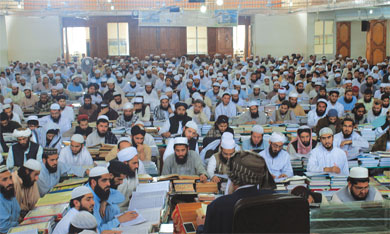
A mega class room at a madrasa |Ghulam Dastageer
Muhammad Hashim appears much younger than he is. Wearing a light blue Shalwar Qameez and a white skullcap, he looks boyishly innocent. Sporting a trimmed brown beard, he can speak only broken Urdu and converses mostly in Pashto, despite having lived in Karachi since his birth in 1989.
He, as well as his six brothers, received their education from Jamia Farooqia, a Deobandi seminary in Shah Faisal Colony, Karachi, where around 3,000 students are enrolled in courses ranging from the memorisation of the Quran to specialisation in Arabic literature and Islamic jurisprudence. After his graduation, Hashim decided to open a madrasa inside his house in Haider Chali, a mostly Pakhtun working-class neighbourhood in Karachi’s north-western Sindh Industrial Trading Estate (Site) area. The two-storey house was purchased in 1992 by his father, Haji Karim, originally a resident of the Swat valley in Khyber Pakhtunkhwa.
Hashim shifted his family upstairs and turned the small bedrooms on the ground floor into classrooms. This is how Al-Karim Islamic Academy – named after Hashim’s father – came into being in 2007. The madrasa provides basic religious education to around 200 boys and girls who mostly live in nearby houses and streets, and pay a monthly fee of 150 rupees each. Being a teacher of the Quran, Hashim is known as Qari Hashim among his students and their families.
A small room that serves as the office of his madrasa has bare brick walls and cemented flooring. The only furniture in it is a tattered sofa and a small wooden table, a copy of the Quran placed on it. On the dusty afternoon of March 23, 2016, Hashim is sitting in this office, explaining how he does not have anything to do with his elder brother, 33-year-old Shakirullah. “He has a mind of his own,” Hashim says of Shakirullah, whose wife and children live upstairs along with the rest of Haji Karim’s family.
"We have never stopped the authorities from examining our premises or questioning our students and teachers. We have nothing to hide."
Shakirullah is on the run. Also known as Mufti Shakir or Mufti Shah, he is reported to be involved in terrorist activities. Al-Karim Islamic Academy is seen as his sanctuary. The police and the paramilitary rangers have repeatedly raided the place since 2014 for his capture. “He is not a mufti, but his friends call him mufti,” says Hashim. Shakirullah received the title while studying at Jamia Farooqia. “He was taking a two year course there in 2006 and 2007,” says Hashim. But Shakirullah dropped out before completing the course and, according to his younger brother, became “reserved and did not share much with the family about his activities”.
In the next few years, Shakirullah allegedly became a major facilitator of terrorism in Karachi. The data maintained by Karachi’s Counter-Terrorism Department (CTD) shows him to be associated with the Swat chapter of Tehreek-e-Taliban Pakistan (TTP). He is also alleged to have provided suicide bombers to the anti-Shia militant group, Lashkar-e-Jhangvi (LeJ). Naeemullah, one of the suicide bombers Shakirullah is reported to have mentored, assassinated Superintendent of the Police (SP) Aslam Khan, known for carrying out deadly anti-Taliban operations in Karachi, on January 9, 2014.
Eight men who attacked a police picket in 2013 near a factory on 3rd Street in Site and injured a police official are known to have links with him, too. Syed Tahir Shah, an assistant sub-inspector at a Site area police station, says “we arrested three of the suspected attackers and they named Shakirullah as the provider of weapons and money to carry out the attack”.
A few months after the attack – on January 24, 2014 – a large contingent of the Sindh Rangers surrounded Al-Karim Islamic Academy at around 11:30 pm. They were looking for Shakirullah but he was not there. “None of us knew where he was,” says Hashim.
Two days later, the rangers raided the seminary again and made Shakirullah’s other brother, Muhammad Akbar, call him. Shakirullah returned home immediately after receiving the call and was instantly arrested. A court in Karachi released him on bail in September 2014 and, according to Hashim, he “stayed with us for a week”. Since then, he has not seen his brother, Hashim says, speaking slowly.
Shakirullah left for some unknown destination and also took his younger brother, Muhammad Usman, with him. “We have not heard from the two since then,” says Hashim.
In the first week of October 2015, law enforcement agencies conducted a third raid on the seminary. Hashim heard his name being announced that day from a loudspeaker and stepped out of the madrasa. He saw a police contingent asking questions from the local residents. The police then probed him, inquiring about Shakirullah. Before calling off the raid, they took another brother, Muhammad Ahmed, into custody. A few weeks later, Ahmed was released but was rearrested soon in a fresh raid at their house.
Syed Imran Ali Shah was seven years old when his father was murdered. Another seven years later, in 1999, he managed to secure admission at Mercy Pak School – an Arab-funded orphanage-cum-madrasa on the outskirts of Peshawar – thanks to one of his relatives who once taught there.
Shah says there was nothing in the madrasa syllabus that preached jihad, yet he was so radicalised by the time he passed his matriculation exam in 2003, that he wanted to join a Jihadi organisation. He blames his passion for jihad on a teacher at the Mercy Pak School who used to deliver regular sermons on the importance and the need for it.
After completing his matriculation, Shah met someone associated with jihad in Indian-administered Kashmir. He received guerrilla training at a camp in Oghi area of Khyber Pakhtunkhwa’s Mansehra District. He claims he could not cope with the rigours of life in the camp and returned home after 35 days to his native village of Wadpagga, situated in the semi-rural periphery of Peshawar.
Many similar stories have appeared in memoirs of Jihadi fighters, academic analyses, research reports, and journalistic exposés. Beginning with the leaders and the cadre of the Taliban in Afghanistan, who are known to have received education in Pakistani madrasas, a large number of suicide bombers and sectarian killers have proven links with madrasas. Just to cite one example, Abdul Rahim Muslim Dost – a former detainee at the Guantanamo Bay prison camp and reportedly one of the main leaders of the Pakistan-Afghanistan chapter of the Islamic State in Syria and Iraq (ISIS) – is a graduate of Al-Jamiat ul Asaria madrasa in Peshawar’s Chamkani area, acknowledges Umer Bin Abdul Aziz, the head of the madrasa.
Feroze Shah, Deputy Inspector General (DIG) in Karachi’s District West, tells the Herald that his department has identified five madrasas in his jurisdiction that help militants procure money and other logistics to carry out acts of terrorism.
Al-Jamiat ul Asaria, founded in 1977, is a large complex of buildings stretched over 10 acres of land. Half of its 535 male students and about 200 of its 530 female students are natives of neighbouring Afghanistan.
Law enforcement officials in different parts of the country verify that some madrasas do not just radicalise their students to wage jihad against their religious and sectarian opponents, but also provide financial resources and logistic support to known religious and sectarian assassins. Feroze Shah, Deputy Inspector General (DIG) in Karachi’s District West, tells the Herald that his department has identified five madrasas in his jurisdiction that help militants procure money and other logistics to carry out acts of terrorism. 12 madrasas in Karachi’s District Central are alleged to be doing the same thing, says a Sindh home department report, seen by the Herald.
In Sindh, 46 madrasas were found in 2015 to be either institutionally linked with militant groups or were facilitating terrorist activities, according to the home department report. In the first three months of 2016, the number of madrasas with “leniency towards militants” has risen to 53. Out of these, 30 are in different parts of Karachi, 12 in Hyderabad, four in Larkana, six in Sukkur and one each in Ghotki and Sajawal.
Some of these madrasas are considered so dangerous that the home department has requested the paramilitary rangers to send out heavily-armed mobile units in aid to the police to conduct raids inside them. These are located in such Karachi areas as Gulshan-e-Maymar, Surjani Town, Mominabad and Orangi Town — mostly in the north-west of the city.
In Punjab, the provincial authorities have found that 200 people, required to notify their movements to the police if and when they need to leave their place of residence – a provision under the Fourth Schedule of antiterrorism laws that restricts the movement of those allegedly linked to banned militant organisations — were working either as teachers or as the administrators of various madrasas in the province. “We have forced them to leave their jobs,” says a home department official in Lahore, seeking anonymity.
The Punjab government has also shut down three seminaries linked to Jaish-e-Mohammad (JeM), a militant organisation that India alleges was involved in a recent attack on its air force base in Pathankot. The closed down madrasas were located in Sialkot, Rawalpindi and Gujranwala — but the JeM headquarters, in a madrasa called Usman-o-Ali in Bahawalpur, remains functional.
Jamia Manzoorul Islamia, a sprawling semicircular complex of multi-storey classrooms and hostel blocks with a courtyard in the middle, is located in Lahore Cantonment’s Saddar area. A Pakhtun gunman greets the visitors as they enter the madrasa and directs them to an office block to the east of the imposing entrance. Some 1,000 students of different ages get free education here. About 700 of them come from places outside Lahore and get free boarding, lodging and meals.
Pir Saifullah Khalid, the madrasa’s founder administrator, came to Lahore from Islamabad and set up the madrasa in 1986. As a visitor hears chants of children reciting the Quran in a large hall, his nine-year-old son, Imdadullah, enters the room and whispers something in his father’s ear. “Shake hands with uncle and tell him your name in English and also tell him where you study if you want me to give you money,” he commands the boy. Imdadullah obliges. “He studies at a private English-medium school,” Khalid says proudly.
Jamia Manzoor ul Islamia is one of the four madrasas in Lahore that the provincial CTD believes to have “militant leanings”. The other three are Jamia Madnia Jadeed on Raiwind Road, not very far from Prime Minister Nawaz Sharif’s sprawling estate; Farooq-e-Azam, also in Lahore’s Cantonment area; and Mohammadia Masjid near Chauburji.
“Prove it,” says Khalid when asked about his seminary’s links with militancy. In the last 12 months, he says, the law enforcement agencies have raided the madrasa three times, late in the night on each occasion. “We have never stopped the authorities from examining our premises or questioning our students and teachers. We have nothing to hide,” he says.
Raids are not restricted to madrasas which focus on providing religious education alone, as Jamia Manzoor ul Islamia does. Far from being an average madrasa where students sit on prayer mats and pore over medieval texts, the modern-looking Jamia Qadria in Rahim Yar Khan was raided in January 2016. Equipped with computers and close-circuit cameras that keep a watch on every nook and cranny of its premises, the seminary appears to be more like a posh private school than a religious education institution. It does not offer religious courses alone — more than half of its students take board and university examinations under the government education system, pursuing their religious studies alongside.
Apart from large-scale operations, small contingents of law enforcement personnel visit madrasas in the region once or twice every month for updated information on the students and the teachers and to keep a watchful eye on the money coming in and going out.
During the raid, over 20 armed police and intelligence agencies personnel barged into Jamia Qadria and closed down its main gate. They searched the premises thoroughly, says Jawadur Rahman, the madrasa’s vice principal. They examined hostel rooms, where students were taking a nap during the afternoon recess, and selected some students randomly and questioned about their antecedents and daily routines. “During the one-hour long search operation, the law enforcement personnel also went over the books in the library and examined the documents at the administration office,” says Rahman.
Since the early 2015 announcement of the National Action Plan (NAP) to eliminate terrorism, such raids have become a matter of routine, especially in the southern parts of Punjab. Apart from large-scale operations, small contingents of law enforcement personnel visit madrasas in the region once or twice every month for updated information on the students and the teachers and to keep a watchful eye on the money coming in and going out.
Qari Muhammad Tahseen, administrator of a Multan-based madrasa, claims intelligence personnel often visit the seminaries, looking for information on whether a madrasa is involved in sectarian violence and whether it is getting funding from abroad. More worrying for him than these queries is another official measure: phones of the administrators and senior teachers are being tapped these days, he claims.
Background interviews with police officials and madrasa administrators in Multan, Bahawalpur and Rahim Yar Khan suggest that the official attitude towards madrasas has shifted from benign indifference in the past to intrusive watchfulness — after the killing of LeJ chief Malik Ishaq, in a reported encounter with the police in July 2015. Government officials feel that Deobandi sectarian elements and their supportive madrasas have been considerably weakened with his death, which the law enforcement departments are using as a helpful development to tighten the security and surveillance noose around madrasas.
“The government is probing all those madrasas that sectarian militants such as Ishaq and his affiliates used to visit,” says Hasan Ahmed Darkhwasti, the administrator of Jamia Abdullah bin Masood in Khanpur town of Rahim Yar Khan. His madrasa itself had hosted Ishaq on several occasions before his arrest and murder because, he claims, the intelligence agencies would advise Deobandi seminaries in the region to keep close contact with people like Ishaq.
Another murder in another part of the province – of Punjab’s home minister Shuja Khanzada at his Attock residence in 2015 – has also forced the government to start looking into the activities of madrasa students, teachers and administrators. Officials in Lahore say the crackdown against madrasas was launched after the militants linked with Jamaat ul Ahrar, a splinter group of TTP, claimed to have assassinated Khanzada through the logistic support allegedly provided by some seminaries.
“We have raided 450-500 madrasas since then. Some raids were intelligence-based while others were random,” says a senior Lahore-based police official. He does not want to be named because he is not authorised to speak publicly on the subject. “We have checked their records, probed their links with militant groups and impounded whatever suspect material we found such as computers, weapons and hate literature,” he says.
Though the raids against madrasas have been discontinued in recent weeks due to the apprehension that those might be seen as being conducted to please the western donors, the official adds, “we continue to do surveillance and carry out intelligence-based action”.
In Karachi, raids are selective and targeted, and are carried out as part of the NAP implementation, officials say. Many madrasa administrators verify that they are regularly questioned about the numbers and the identities of their students as well as the names and the institutional affiliation of any guests that they ever have.
In Khyber Pakhtunkhwa, according to a list compiled by the Special Branch of the provincial police, 76 madrasas have been put under highest official surveillance. Only two of these are in Peshawar.
Yet most of them see these measures as a routine exercise which is yielding no tangible results. “I do not know if any madrasa has been shut down in Karachi as a result of search operations,” says Maulana Umer Sadiq, a local leader of Jamiat Ulema-e-Islam—Fazl (JUI-F), which runs many madrasas in the city’s District West. Abdul Kareem Bukhari, another madrasa administrator in the same district, is also not convinced that the operations are effective. “I can assure you that the police have not arrested a single person in District West,” he claims.
The government officials dismiss these claims as propaganda meant to portray that nothing sinister is going on inside the madrasas. They cite a recent home department report to claim that at least one person, Ismail Shah, was arrested from a madrasa inside Mustafa Masjid in Site area for possessing and distributing Jihadi literature in the neighbourhood.
Another report, prepared last year by the same department, says around 167 madrasas have been forced to close down across Sindh for their suspected links with militancy and sectarianism. None of these sealed madrasas, however, happen to be in Karachi. The authorities also refuse to reveal the names, locations and sectarian identities of the sealed institutions.
The officials have compiled a detailed list of all the madrasas in the province and have geotagged a large number of them so that the coordinates of their location are precisely mapped in the government records and a photo or another visual of their premises is available in the official files. The following is a division-wise breakdown of the madrasas as per the list which puts the total number of madrasa students in the province at 517,695:
In Khyber Pakhtunkhwa, according to a list compiled by the special branch of the provincial police, 76 madrasas have been put under high-level official surveillance. Only two of these are in Peshawar. The highest number of madrasas under the strictest surveillance (18) is in Lakki Marwat; the second highest number (13) is in Dera Ismail Khan; and the third highest number (10) is in Bannu.
In Punjab, authorities claim they have geotagged all the 14,000 or so madrasas in the province, although a large number of them are not even registered with any government department. “We have collected complete data on the number of children enrolled in these madrasas. We also know how many foreign students are enrolled and in which madrasa,” says a Lahore-based official, who does not want to be named.
The way the Punjab government is moving towards the seminaries is causing a lot of discomfort among the madrasa administrators. “We are fine with the collection of information and any other queries, but the government officials must conduct those exercises in a decent way; they should not humiliate and harass the people in seminaries through unnecessarily aggressive actions,” says the administrator of a madrasa in Multan. “The law enforcement agencies mostly treat the teachers and students of the seminaries as criminals,” he claims.
Others complain the government treats madrasas as hatcheries of terrorism, even when there is only circumstantial evidence of it. “Intelligence agencies came to know that a man named Umar, who happened to be a close aide of LeJ’s deceased chief, was once a student at our madrasa. The officials came to us and started questioning us about him as if we are responsible for all the acts of all our former students,” says Azizur Rahman Darkhwasti, the administrator of Jamia Arabia Makhzanul Uloom, a prominent Deobandi madrasa in Rahim Yar Khan’s Khanpur town.
Mohsin Rahmani, a teacher at the same madrasa, recounts how the law enforcement personnel registered a case for promoting sectarian hatred against the administrator of a local seminary over the possession of a book of Deobandi beliefs which, he claims, did not incite any hatred towards anyone.
Administrators of madrasas in Rahim Yar Khan also like to cite the case of Shafiqur Rahman, a Khateeb (scribe) at a local mosque, to claim that the cases against people linked to madrasas are being registered on whim. Rahman himself claims to have been victimised for publicly opposing a ban imposed by the district police officer on the collection of donation for madrasas. “The officer was so displeased that he booked me for violating the Punjab Sound Systems Regulation Act during the Friday prayers,” he says.
Shafiqur Rahman was able to secure an acquittal from a court but the police have still put his name in a list of people whose movements are governed by the Fourth Schedule, due to alleged links with terrorist organisations. “I have never attended any public meeting by any sectarian or extremist organisation,” Shafiqur Rahman says in his defence.
The intensity of government actions has forced some madrasas to take unprecedented precautionary measures. Jamia Qadria, for example, checks the personal belongings, mobile phones and hostel rooms of the students every month to ensure that they are not doing anything that may land their institution in trouble with the government. Three students were expelled a couple of months ago after badges supporting Sipah-e-Sahaba Pakistan, an outlawed anti-Shia organisation, were found in their bags, says Vice Principal Jawadur Rahman.
Some senior law enforcement officials in Lahore believe that madrasas are not “directly involved in terrorism” and, therefore, must not be punished for the individual acts of their graduates.
Government officials in southern Punjab claim they have solid reasons to conduct raids. “Terrorists apprehended recently were once linked to certain madrasas. That is why the police are probing the seminaries they had been associated with,” says SP Irfan Samo in Rahim Yar Khan. He denies being harsh or selective, let alone personal, in these probes. “No specific sects or persons are our targets, and madrasas belonging to all sects and schools of thought are being treated equally.”
Many madrasa administrators protest that the official measures are aimed at nothing else but maligning the institutions of religious learning. “Midnight raids, sieges of madrasas and harassment [are meant to] please the Western countries,” says Mufti Attaur Rahman, principal of Jamiat ul Madina, a madrasa in Bahawalpur. “Countless criminals and terrorists have studied at schools, colleges and universities but the government never raids their educational institutions. Why then does the government harass madrasas for the individual acts of their former associates?” he asks.
Some senior law enforcement officials in Lahore echo his concerns. They believe that madrasas are not “directly involved in terrorism” and, therefore, must not be punished for the individual acts of their graduates. Their argument: most suspects involved in acts of terrorism at home and abroad come from mainstream educational institutions and reputed Pakistani and foreign universities. “Should those universities and colleges also be shut down?” asks one senior police official.
He, therefore, opposes “stereotyping” madrasas as “breeding grounds of militancy and militants” and insists that “we, as society, have massively been radicalised over time”. This situation, he says, “cannot be reversed by demonising madrasas and their students alone”.
When Syed Imran Ali Shah received admission at Mercy Pak School 17 years ago, his family had no idea that the madrasa-cum-orphanage was affiliated with the Wahhabi/Salafi school of thought. His widowed mother was actually happy that he was to receive free education from a quality institution.
Coming from a traditionalist Sufi family, he started feeling like an alien in the madrasa as his education proceeded. “I was, perhaps, the only student who did not follow the madrasa’s Wahhabi ideology,” Shah tells the Herald. “Almost all the teachers of the orphanage were Wahhabis,” he says. And even though the curriculum of the madrasa did not have any ostensibly sectarian contents, he says, the students over the passage of time were so brainwashed that they would consider many beliefs and practices of people belonging to other sects as heresy.
His name, with Ali and Shah in it, is a popular name among the Shias and, therefore, earned him the reputation of being a Shia in the madrasa, even though he comes from a Sunni family. He remembers a scuffle with a fellow student over sectarian differences vis-à-vis religious personages.
The administrators everywhere claim they do not teach their students to hate other sects, but interviews with teachers and students amply prove that the madrasas play a key role in moulding the sectarian identities of their graduates. Most of them do not hesitate from pronouncing their sectarian beliefs publicly. Umer Bin Abdul Aziz, the administrator of an Ahl-e-Hadith madrasa in Peshawar, does not mince his words when he debunks many Barelvi beliefs even in his casual conversations. He also appears to be vehemently opposed to the beliefs of Shias.
In Barelvi madrasas, too, feelings towards the members of other sects are of distrust if not outright hostility. Muhammad Saad Junaidi, a 19-year-old student at Peshawar’s main Barelvi madrasa, Jamia Junaidiyah Ghafooriyah, does not deem it right to offer prayers led by an imam who belongs to another sect.
Syed Jawad Hadi, administrator of Jamiatus Shaheed Arif Hussain Lil-Maarif al-Islamia, acknowledges that the way the Shia madrasas implement Dars-e-Nizami curriculum is quite flawed. Precious little is taught about the lives of the first three Muslim caliphs in the Shia seminaries, he admits. “It’s not the right thing. Their services to Islam should also be taught about in the Shia madrasas.”
Some madrasa administrators still want everyone to believe that their educational institutions do not have any role in spreading sectarian sentiments and inciting religious violence.
Motivated by his cross-sectarian impulses, he gathered administrators of 40 madrasas of Peshawar at his seminary about a decade ago with three objectives in mind: to devise a uniform syllabus; to organise exchange visits for madrasa teachers; and to arrange similar exchange visits for madrasa students. The initiative could not bear fruit because the then provincial government – run by a coalition of six religious political parties – wanted to take credit for it while most of the madrasa administrators involved in it wanted to keep it free from politics, says Hadi.
Some madrasa administrators still want everyone to believe that their educational institutions do not have any role in spreading sectarian sentiments and inciting religious violence. Maulana Samiul Haq, the head of Darul Uloom Haqqania in Akora Khattak that prides itself on being the alma mater of many prominent Afghan Taliban leaders, obfuscates the subject of sectarian violence by blaming it entirely on the rivalry between Iran and Saudi Arabia, as if Muslims never had any sectarian problems before that.
And he self-contradicts without blinking an eye. After claiming that no terrorists have ever had any links to any madrasa in Pakistan, Haq says Iran and Saudi Arabia generously fund madrasas in Pakistan to promote their respective sectarian agendas. The madrasas receiving these funds are either bastions of peace or they are the fountainheads of sectarian violence. They cannot be both at the same time.
Haq then argues that the madrasa curriculum does not discriminate between the books written by authors belonging to different sects — or even different schools of thought. “We are Hanafis, but none of the compilers of the six most authentic collections of Hadith was a Hanafi. Still, we teach their books,” he says without explaining that in this case, he is referring to different schools of jurisprudence within Sunni Islam, rather than the sectarian division between Sunnis and Shias.
To confound things even further, he says the madrasa curriculum also includes the poetry of Imru al-Qais, a pre-Islamic Arab poet, without specifying that it is part of the syllabus meant only for specialisation in Arabic grammar and language — a higher qualification that only few madrasa students opt for.
Gaps like these are ubiquitous. When Hafiz Muhammad Ejaz, a senior administrator at Islamabad’s Jamia Salfia proudly shows the Herald that his madrasa has a book by the 12th Century rationalist Muslim philosopher Ibne Rushd (known as Averroes in the West) in its syllabus, he fails to hide the next entry — a book to negate the beliefs and practices of the Ahmadis.
Some insiders know these contradictions are too glaring to brush aside and are, therefore, unapologetic about their sectarian character. They see Aqeedah – how and what people believe – as the basis for sects and madrasas. The madrasas, according to them, have a role in imparting the correct Aqeedah to their affiliates. “We teach the students the Aqeedah of every sect and tell them as to how and where that Aqeedah is wrong so that we can then guide them to the right Aqeedah,” says Umer bin Abdul Aziz of Jamiatul Asar in Peshawar.
What if the students then want to fight with those who have the wrong Aqeedah? Instead of bringing people to the right Aqeedah through violence, they should be convinced through argument, he responds. The long history of sectarian violence in Islam shows that sectarian schisms run deep and hardly ever yield to reconciliation through arguments. That there are so many sects in Islam only means that none of them has been able to clinch the argument in favour of its Aqeedah.
The administrators everywhere claim they do not teach their students to hate other sects but interviews with teachers and students amply prove that the madrasas play a key role in moulding the sectarian identities of their graduates.
Another insider is even more candid about the role of madrasas, and their administrators and teachers in spreading sectarianism. “They are lying if they say they do not influence their students directly or indirectly,” says a Deobandi madrasa teacher in southern Punjab. “They are the reason why madrasa students dislike the beliefs and practices of people from other sects or schools of thought.”
And outsiders readily agree. Syed Kamran Ali Shah Qadri, the editor of a Peshawar-based religious monthly magazine Mazhab-i-Amn (which translates as “the religion of peace”), is a champion of interfaith harmony. He believes sectarian ideology is systematically instilled into the minds of the students who enter madrasas at a very tender and impressionable age.
But the madrasa representatives avoid making public the unpalatable aspects of madrasa education, says Dr Niaz Muhammad, a researcher at the Abdul Wali Khan University in Mardan, who has carried out textual analysis of madrasa books. “No one should claim that their statements about the madrasa curriculum have nothing to do with sectarianism or other forms of religious militancy to match the reality,” he says.
Even outside Pakistan, religious education remains mostly sectarian — most obviously in places such as Iran, Iraq and Saudi Arabia. On the other hand, one internationally renowned institution of religious learning, Cairo’s historic Al-Azhar University, has focused on developing critical faculties among its graduates rather than cramming them with controversial histories and even more controversial interpretations of religious texts. “I did not find any sectarian bias in the curriculum at Al-Azhar where people from 114 different nationalities and belonging to different sects study together,” says Khalid Raza, who is pursuing a degree there after graduating from a Barelvi madrasa in Peshawar.
“A narrow lane, lined on either side with overflowing open drains and strewn with garbage, winds through rundown unpainted barrack-like houses with broken windows and walls festooned with posters of rival political parties,” wrote Yoginder Sikand, a leading Indian author on Islam, in an essay, titled Lost Legacy of South Asia’s Leading Centre of Islamic Learning. “Goats sniff through piles of vegetable peels and rotting fruit. Ahead, an enormous mound of bricks and mud squats like a crumbling pyramid. A thin slice of wall peeks out from the rubble. The serpentine roots of a peepul tree grow out of what was once a delicately-carved dome. This was once the grand Firangi Mahal,” he wrote.
Firangi Mahal (foreigner’s palace) — “or whatever is left of it — is located [in Lucknow] off a busy road constantly clogged with slow-moving traffic,” Sikand noted. Originally the residence of a European visitor to India, it was handed over to the family of two religious scholars in the 17th century by Mughal Emperor Aurangzeb. The scholars turned it into an institute of religious learning, thereby starting a long line of distinguished men of religion known as the Ulema of Firangi Mahal who have played an important role in various social and political movements of the Muslims in India, including the Khilafat Movement in the 1920s and the movement for independence from the British in later decades.
The Ulema of Firangi Mahal were closely associated with the Mughal Empire and were instrumental in introducing the 11th Century Muslim religious curriculum, known as Dars-e-Nizami, to the Indian subcontinent — and subsequently to Pakistan and India. The story goes something like this: when the East India Company purchased the right to collect revenue in the Mughal provinces of Bengal, Orissa and Bihar from Emperor Shah Alam, one of the clauses in the purchase agreement was that the British company will not change the legal and administrative systems in those provinces. Obliged by the need to train judges and administrators to run those systems – mostly operating under Hanafi Muslim laws – the company needed to devise a curriculum for the schools that it wanted to set up for its prospective employees in the provinces it was to run. Mullah Nizamuddin, a scion of the Firangi Mahal family, had devised an education curriculum around the same time, which, according to Sikand, “combined Sufi treatises, Islamic texts as well as books on the ‘rational’ sciences such as geography, logic, medicine, philosophy, literature and mathematics.”
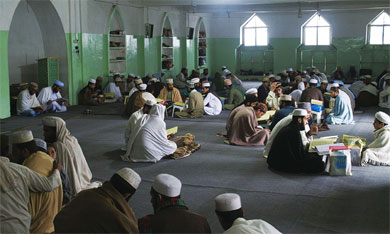


Students at Jamia Junaidiyah Ghafooriyah, a Barelvi madrasa in Peshawar
Post-1947, Dars-e-Nizami has experienced substantial changes mostly because of sectarian reasons. “The Barelvis and Deobandis have retained only 25 to 30 per cent of the original Dars-e-Nizami,” Dr Niaz Muhammad tells the Herald.
This syllabus was an adapted version of the original Dars-e-Nizami devised by Abu Ali Hasan ibn Ali Tusi – known as Nizam al-Mulk – for the higher education institutions he set up as the prime minister of the Seljuk Sultans, about six centuries earlier. These institutions were called Nizamiyyah after him and their curriculum was consequently known as Dars-e-Nizamiyyah or Dars-e-Nizami.
In Mullah Nizamuddin’s Dars-e-Nizami syllabus, the Quran and Hadith were only marginally studied; the former via two commentaries, the latter through one abridgement, says Barbara D Metcalf, the author of Islamic Revival in British India: Deoband 1860-1900. This Dars-e-Nizami became the core syllabus for all Islamic – mostly Sunni – madrasas that were later opened in different parts of British India, staring with what was then known as the United Provinces (UP) in places such as Deoband (in 1867) and in Rae Bareli (in 1904). These two places have subsequently become respectively synonymous with Deobandi and Barelvi sub-sects of the Sunni Islam in the Indian subcontinent. One of Mullah Nizamuddin’s own successors, Maulana Abdul Bari, who “played a leading role in India’s struggle for independence”, as Sikand tells us, also set up Madrasa Nazmia in Lucknow in 1913.
Post-1947, Dars-e-Nizami has experienced substantial changes mostly because of sectarian reasons. “The Barelvis and Deobandis have retained only 25 to 30 per cent of the original Dars-e-Nizami,” Dr Niaz Muhammad tells the Herald. However, “madrasas linked to the Shia and Ahl-e-Hadith sects as well as those linked to the Jamaat-e-Islami political party have almost entirely replaced Dars-e-Nizami with curricula of their own.”
Muhammad notes that the most important change to have taken place in Dars-e-Nizami is that it has shifted away from imparting the knowledge of Ma’aqulat (rational sciences) to rote learning and interpretation of Manqlat (received religious texts). This is because the main purpose of the current curriculum is to train religious teachers and prayer leaders, he says.
That shift also explains why a madrasa administrator in Lahore is not enthusiastic about adding any non-religious subjects to the curriculum. “What is the use of these subjects for children being trained in religious education?” asks Pir Saifullah Khalid of Jamiatul Manzoor.
Dr Amir Tauseen, an expert on Dars-e-Nizami curriculum who heads a federal government institution in Islamabad – Pakistan Madrasa Education Board – points out that the commentaries on the compilations of Hadith differ in the syllabus of madrasas belonging to different sects and are major contributors to sectarianism. “Courses related to sectarian subjects have been introduced as part of the teaching of Hadith,” he says.
Dr Tahir Mehmood, the principal of Jamia Salfia in Islamabad’s H-8 Sector, talks about some other changes which, he says, have been necessitated by the changing times. “The original Dars-e-Nizami included the learning of Greek philosophy,” he says, “but the age we are living in is not the age of philosophy”. Most madrasas, therefore, “teach Greek philosophy only with the help of a 20-page summary”. The focus, he says, “has shifted to computer science” which has now become an integral part of the instruction at many madrasas across Pakistan.
There have been multiple attempts to change – if not reform – the madrasa education system in recent times. For instance, the teaching of some non-religious subjects – such as mathematics, Urdu, Pakistan Studies – was introduced in the 1980s, when the government was generously supporting madrasas financially. The introduction of those subjects allowed madrasa graduates to sit for the examinations conducted by the government boards and universities. Other administrative changes around that time helped thousands of madrasa graduates to get bachelors and masters degrees in subjects such as Arabic and Islamic Studies by passing matriculation and intermediate examinations in some compulsory subjects such as English and Pakistan Studies. Most of those students later became Arabic and Islamic Studies teachers at thousands of government schools when these two subjects were declared compulsory during the martial law regime of General Zia ul Haq.
Madrasa administrators remember General Zia ul Haq as their greatest benefactor who, according to Pir Saifullah Khalid, “used to finance madrasas with public money.” That channel dried after the Zia era came to an end in a plane crash. “We then had to turn to charitable donors at home and abroad for funds to meet our expenditure,” he tells the Herald. “How else you expect us to finance our expenditure?”
Khalid does not favour any restrictions on the flow of money to the madrasas because that money, according to him, is being used for “educating poor children”.
Officials in the federal government have a different viewpoint. Many madrasas are getting money from abroad and not all of it is being used to impart education, they say. Out of more than 250 madrasas closed down across Pakistan in recent months, according to an intelligence official, around 100 were sealed on the charges of receiving foreign funds from dubious sources. The action, he says, was taken on the basis of intelligence reports. The number of madrasas getting foreign funding of suspect nature may turn out to be much higher if a proper audit of it is done in all those madrasas receiving money from abroad, he adds. According to an unofficial count by Mufti Abdul Qavi, a Multan-based Sunni religious scholar, the number of such madrasas is 280.
Khalid insists the madrasas cannot ask the donors about the source of their money. “We are ready to give our accounts for audit, but will not disclose the source of funds. Why should we do that if the donors don’t want to be named?”
The government appears resolute about doing just that. “All the madrasas receiving foreign funding have been put under strict government surveillance,” says Qavi, highlighting the government’s intentions.
In a big hall inside the vast campus of Jamia Faridia –one of the largest seminaries in Pakistan – three neatly turned out teachers are taking three separate classes, each comprising 12 to 15 students. Dressed in white cotton Shalwar Qameez, each teacher is providing lessons on memorising the Quran. After spending three hours in classes of religious instruction, says Muhammad Ahmed, a senior student of the seminary, the students will spend an hour learning worldly subjects such as English, science, mathematics and Pakistan Studies.
In a small room, a little while later, some 12 students start taking lessons in basic science and geography. “If you go into space and look towards the planet earth, it will appear blue to you; the blue colour indicates the presence of water on earth,” Muhammad Ayub, a young teacher, is telling the students, many of whom come from Kashmir and Khyber Pakhtunkhwa.
Before July 2007, about 3,000 students were enrolled at Jamia Faridia. Many of its students then joined the administrators of Islamabad’s Lal Masjid in an armed revolt against the state. The seminary subsequently remained closed for more than a year and was allowed to reopen only after intense negotiations between the government and its administrators. One of the main official conditions for reopening the seminary was that it should reduce its enrolment. Letting a madrasa in the heart of the federal capital have a huge student body will always run the risk that those studying there become unruly – as they did during the bloodied debacle at Lal Masjid – and create a law and order situation, as the authorities feared.
Letting a madrasa in the heart of the federal capital have a huge student body will always run the risk that those studying there become unruly – as they did during the bloodied debacle at Lal Masjid – and create a law and order situation.
“There are only 1,300 students in Jamia Faridia now,” says Ahmed. The madrasa is also under strict government surveillance.
Another madrasa in the same city is under absolutely no official regulation, let alone surveillance. “There is no contact with the government,” says Dr Tahir Mehmood, principal of Jamia-e-Salfia, the largest Ahl-e-Hadith seminary in Islamabad.
This inconsistency is about to change if officials at the federal interior ministry are to be believed. The ministry is in the process of devising a surveillance regime for all the madrasas in the country, aimed at centralising all the relevant data and getting regular updates on any changes at any of the madrasas in Pakistan. The system being put in place will require the management of madrasas to submit instant reports “about every development in their seminaries,” as one official in Islamabad puts it. If and when, for instance, a student or a teacher migrates from one seminary to another, both the seminaries will have to report this development to the interior ministry.
“The National Database and Registration Authority (Nadra) has been tasked to develop software for this system,” the official says. The surveillance mechanism envisions the setting up of a server at the interior ministry’s headquarters in Islamabad to house the central database; every madrasa will be linked to this database through a computer terminal provided by the ministry which will also carry out on-site inspections through intelligence agencies and the local police to verify and cross-check the information being received from individual madrasas, the official tells the Herald without wanting to be named.
One of the main hurdles the planned system is facing is the reluctance among the madrasa administrators to agree to it. The government remains adamant that they have to. Federal Interior Minister Chaudhry Nisar Ali Khan was unequivocal when he told the representatives of madrasa administrators in a meeting in Islamabad on January 17, 2016, that they have no option but to accept a strict monitoring and surveillance system.
Parleys between the government and the office-bearers of Ittehad Tanzeem ul Madaris – an umbrella organisation of all the five madrasa associations in the country (representing four sects – Deobandi, Salafi, Barelvi, Shia (and a political party, Jamaat-e-Islami) – have been going on for months. “During the last six months, Prime Minister Nawaz Sharif, Chief of the Army Staff General Raheel Sharif and Interior Minister Khan have had multiple meetings with the madrasa representatives,” says a senior office-bearer of Wifaq ul Madaris al-Arabia (an association of Deobandi madrasas). “In every meeting, we were told to cooperate with the government,” he says.
The decision to bring madrasas under strict vigilance was taken at the highest official level “after it became apparent that most of the terrorist attacks during the last three years could be traced back to madrasas,” says a senior interior ministry official.
As a first step to implement a surveillance system, the interior ministry started a registering process three months ago. In a related measure, the provincial governments were told to perform the geographical mapping of all the madrasas within their jurisdiction. The process of geo-tagging has been completed in Punjab and is at a very advanced stage in Sindh but it has not even started in Khyber Pakhtunkhwa and Balochistan.
The main objectives of the government drive are: a) to get all the madrasas registered by the middle of this year; b) to convince the madrasa managements to carry out all their financial transaction through banks; and c) to convince madrasas to get their accounts audited through government authorised auditors.
The progress on all three counts has been slow. The representatives of madrasa associations cite “practical obstacles in the way of implementation” of the official demands, says an official of the National Counter-Terrorism Authority (NACTA), a recently constituted government body. While the money-related requirements have been rejected out of hand by madrasa administrators, the registration process has also been bogged down mainly due to the differences between the madrasa associations and their affiliates.
“The government has been able to register only around 8,000 madrasas out of the 33,000 known to exist across Pakistan,” says a senior government official in Islamabad. And this is in spite of the fact that the registration process has been going on since the London bombing carried out by men of Pakistani origin in 2006, who had attended madrasas in Pakistan. The task was originally assigned to the federal ministry of religious affairs which, according to interior ministry officials, was more interested in appeasing the madrasa managements than in registering them. The assignment has now been given to the interior ministry which has enlisted the help of provincial home departments to do it.
The other factor hampering the registration process is more protracted. Many madrasa administrators see the representatives of their associations to have surrendered their autonomy to the government. “We have reports that a large number of madrasas have revolted against their respective associations, accusing them of agreeing to an intrusive inspection and surveillance regime,” says a senior government official in Islamabad. “More than 40 per cent of the madrasas just refused” when the associations distributed a seven-page registration form among their affiliates. The madrasas in revolt, according to the official, mostly belong to the Deobandi sect.
A related problem is a long-standing demand by the madrasa associations that their examinations and degrees enjoy the same status as that accorded to the examinations and degrees of the government boards and universities. For years, the madrasa representatives have been putting forward this demand as a precondition to allowing the registration process to go ahead. In recent months, however, the government has reversed the situation by insisting that the madrasa examinations and degrees will get the official recognition only if the registration process is completed without delay, says an interior ministry official. The two sides, however, are yet to arrive at an agreement on the issue.
The government is complementing its negotiations with the representatives of madrasa associations through other efforts to register madrasas: religious ministry officials are talking to the managements of those madrasas which are not affiliated to any of the five associations so that they register themselves with the Pakistan Madrasa Education Board (PMEB). “There are 5,000 such madrasas throughout Pakistan,” says the board’s chairman, Dr Aamir Tauseen. Out of these, he says, “1,500 madrasas have agreed to affiliate themselves with the board.” Those ready for affiliation belong to the Deobandi sect.
PMEB was set up in 2001 through an ordinance with the objective of modernising the madrasa curriculum. It was also supposed to oversee the functioning of five madrasa associations. The board, however, has faded into the background for several reasons, not the least because it has been functioning with next to no money for the last 10 years.
That clearly explains that the government’s efforts for regulating madrasas lack consistency. Once the current furore over the links between religious and sectarian terrorism and the madrasas subside, will the government pursue the issue with the same vigour as it is exhibiting now? The question is moot.
Source:herald.dawn.com/news/1153383
- See more at: http://newageislam.com/islamic-society/umer,-moosa,-nasir,-ghulam-and-saher/concealed-truth--what-is-wrong-with-madrasas-in-pakistan?/d/107132#sthash.c3JA8ApR.dpuf