--------
25 killed in drone attack in North Waziristan
Omer Farooq Khan, Apr 22, 2011,
ISLAMABAD: Despite Pakistan's differences with the US over the CIA-driven drone operations in its tribal areas, two unmanned aircrafts fired four missiles on a large compound in North Waziristan on Friday, killing at least 25 people.
The fresh strikes came two days after Pakistan's army chief, Gen Ashfaq Pervez Kayani, told the US military's top official, Admiral Mike Mullen, that such strikes complicated Pakistan's war against the militants. On Wednesday, Mullen also expressed his country's concern in Islamabad over the continuing links between Pakistan's main spy agency, the ISI, and militants attacking US-led forces across the border in Afghanistan.
According to intelligence officials, four missiles were fired on a large compound in the town of Spinwam in North Waziristan on Friday.
"At least 25 people were killed in the attack, including five women and four children in a nearby house," officials said. The compound was occupied by supporters of local militant commander Hafiz Gul Bahadur.
The US considers the area as safe haven for al-Qaida and Taliban militants. A similar attack in North Waziristan on March 17 killed more than 50 people, 40 of them tribal elders who had gathered to attend a tribal meeting for resolution of land dispute. Gen Kayani, in a rare public condemnation, called the attack "intolerable and unjustified".
The United States has been using drone attacks to target al-Qaida-linked militants since 2004 in Pakistan's lawless tribal areas but such strikes recently became a source of concern for the country, which says civilian casualties stoke public anger and bolster support for extremists. Since the US president Barack Obama took office, the attacks had intensified in the tribal areas. More than 100 raids were reported in 2010. Many militants, including their senior leadership, have been killed in drone strikes, but hundreds of civilians have also lost their lives.
http://timesofindia.indiatimes.com/world/pakistan/25-killed-in-drone-attack-in-North-Waziristan/articleshow/8058022.cms
--------
Eight NATO troops killed as Afghan pilot opens fire
April 27, 2011 AFP KABUL
Eight NATO troops and a contractor were killed when an Afghan pilot opened fire on Wednesday after a row at a Kabul training centre in one of the deadliest such attacks since the US-led invasion in 2001.
The killings appeared to stem from an argument rather than terrorism, but served to highlight the prevailing insecurity in Afghanistan, 10 years after foreign troops ousted the Taliban from power.
They were also likely to raise questions over a massive NATO-led effort to expand and train Afghanistan's military and police so they can take over when foreign combat operations are scheduled to end in 2014.
The NATO-led training mission in Afghanistan confirmed that eight international troops and a contractor died in the shooting but did not reveal the nationality of the troops killed in line with policy.
Afghan defence ministry spokesman Mohammad Zahir Azimi earlier gave further details of the clash, which is now over.
"At around 11:00am (0630 GMT) within the air force compound, an argument took place between an (Afghan) air force officer and foreign colleagues," he said. "An exchange of fire followed. A number have been killed and injured."
The Afghan pilot was shot dead by Afghan soldiers following the killings, which took place at a site shared by Kabul's military and civilian airports, he added.
The Taliban claimed responsibility for the incident in a text message to AFP, although the militants are known routinely to exaggerate their claims.
But an Afghan official, speaking on condition of anonymity, identified the gunman as a 50-year-old pilot from a well-respected Kabul family, and said the shooting was the result of an argument and was not a terrorist act.
The pilot is thought to have used a pistol in the shooting, the source added.
The deaths are thought to represent the highest number of foreign forces killed in a single incident since September, when nine ISAF troops were killed in a helicopter crash in southern Afghanistan.
It is also thought to be the deadliest incident for NATO troops at the hands of an Afghan dressed in military uniform.
There is a history of Afghan forces attacking foreign soldiers who have been mentoring them ahead of limited foreign troop withdrawals due in July.
NATO efforts to train and equip local forces so they can take responsibility for security across Afghanistan by 2014 have been hit by a string of attacks by militants who have apparently infiltrated the armed forces or who attacked while wearing unauthorised uniforms.
Last November, six US troops were shot dead during a training session in eastern Afghanistan, apparently by a member of the Afghan border police.
The defence ministry in Kabul was targeted last week by a gunman in army uniform wearing a suicide vest, in an attack that left three people dead.
Earlier this month, another attack at a military base in the east killed nine including five foreign troops and four Afghan soldiers, while the police chief of Kandahar in southern Afghanistan was also assassinated.
Monday's killings took place at NATO's Air Training Command Afghanistan centre, according to a spokesman for NATO's training mission in Afghanistan.
The mission's commander, Lieutenant General William Caldwell, has called 2011 a "pivotal" year in which the total number of Afghan military and police should rise to over 300,000. The figure currently stands at over 180,000.
He has said that the overall cost of the mission is some 40 billion dollars.
There are around 130,000 international troops serving in Afghanistan, the bulk of them from the United States, although Afghan forces are in control of security in Kabul.
http://www.deccanchronicle.com/channels/world/middle-east/eight-nato-troops-killed-afghan-pilot-opens-fire-647
--------
Blast hits Pakistan navy bus, several casualties
28 April 2011
KARACHI - A blast hit a bus carrying Pakistani navy officials in the southern city of Karachi, on Thursday, causing some casualties, a security official said.
“Till now we have reports that 15 people have been injured,” said Sharfuddin Memom, a spokesman for the Sindh provincial government. Karachi is capital of Sindh.
Two bombs hit buses carrying navy personnel on Tuesday, killing four people and wounding 56.
Karachi is Pakistan’s biggest city and commercial hub. It is also home to the main base of Pakistani navy.
Militants linked to Al Qaeda and Taliban have carried out several attacks in the sprawling city since Pakistan joined the US-led war against terrorism in 2001.
Experts say the navy may have been targeted because it is seen as less well-defended than the army and the air force which are leading the fight against militants.
In 2002, 11 French engineers and technicians working on the construction of submarines for the Pakistan navy were killed along with three Pakistanis in a suicide bombing outside a hotel in Karachi.
http://www.khaleejtimes.com/DisplayArticle08.asp?xfile=data/international/2011/April/international_April1210.xml§ion=international
--------
Gaddafi has become liability for Libya: Britain
April 28, 2011
Lalit K Jha
Libyan leader Muammar Al Gaddafi has become a “liability” for his people and the sooner he recognises his “game is up” it is better, British Defence Secretary Liam Fox has said.
“The sooner that Colonel Gaddafi recognises that the game is up, however, today or shortly, the better. He is a liability for his people and his country, and the sooner that he gets this message, the better,” Fox told Pentagon reporters at a joint media availability with his US counterpart Robert Gates.
“It is also appalling for us to see the sight of young mercenary soldiers being pushed to the front of lines in places like Misurata, and it’s a sign of desperation from a regime that they resort to these sorts of tactics,” he said.
In a meeting that lasted for three hours at the Pentagon, the two leaders discussed the situation in Libya.
“We’ve seen some momentum gained in the last few days. We’re very grateful to the United States for making the armed Predators available and for the difference that makes in helping us to be able to hit more ground targets. We’ve seen some progress made in Misurata, and it’s very clear that the regime is on the back foot,” Fox said.
http://www.dailypioneer.com/334844/Gaddafi-has-become-liability-for-Libya-Britain.html
--------
'Give up war or face assassination', Liam Fox warns Gaddafi
April 26, 2011 ANI London
British Defence Secretary Liam Fox has warned Libyan leader Colonel Muammar Gaddafi and his loyalists to give up their fight against civilians in that country or face possible assassination.
“If the regime continues to wage war on its people, those who are involved in those command-and-control assets need to recognise that we regard them as legitimate targets,” the Daily Mail quoted him, as saying while leaving for the US.
Full report at:
http://www.deccanchronicle.com/channels/world/europe/give-war-or-face-assassination-liam-fox-warns-gaddafi-268
--------
Pak tries to outflank US and India in Kabul with China card
Chidanand Rajghatta
Apr 28, 2011
WASHINGTON: The diplomatic form book shows that every time Pakistan is hauled up by its longtime patron United States, its leaders hare off to Beijing or Riyadh for solace and stash, comfort and cash. Small change in the script this time.
Shortly before the top American military official Mike Mullen virtually called Pakistan a terrorist state last week, a charge compounded by Wikileaks cables showing Washington's profound distrust of Islamabad, Pakistan's prime minister Yousuf Raza Gilani hotfooted it to Kabul. There, flanked by his military supremo Ashfaq Kiyani and chief spook Shuja Pasha, he is said to have made an audacious pitch to the beleaguered Afghan President Hamid Karzai: Let's both ditch US and hitch our stars to China.
Full report at:
http://timesofindia.indiatimes.com/world/us/Pak-tries-to-outflank-US-and-India-in-Kabul-with-China-card/articleshow/8103858.cms
--------
US, Pak cannot allow security ties to unravel: Mullen
Omer Farooq Khan
Apr 20, 2011
ISLAMABAD: The shuttle diplomacy has been underway to calm the lingering differences between the US and Pakistan on a number of issues as the Afghan imbroglio heads towards the start of the so-called endgame.
To accommodate each other's strategic concerns, Admiral Mike Mullen, the Chairman of the US Joint Chiefs of Staff, who arrived in Islamabad on Wednesday, met the country's military leadership.
Last week, Pakistan's foreign secretary Salman Bashir had flown to Washington to meet the American officials on Thursday and Friday.
These high-profile meetings are the latest in efforts to overcome the differences which broke into the open since a CIA contractor, Raymond Davis, shot dead two Pakistani men in Lahore in January. The subsequent drone strikes that killed 40 tribal elders in North Waziristan a day after Davis was released brought the relations between the two countries to its lowest ebb.
Despite the stalemate, the two countries recognize their importance for each other at this critical phase when the US authorities will start preliminary withdrawal of its troops from Afghanistan in July.
Full report at:
http://timesofindia.indiatimes.com/world/pakistan/US-Pak-cannot-allow-security-ties-to-unravel-Mullen/articleshow/8039059.cms
--------
Pak admits majority killed in drone strikes are terrorists
Mar 9, 2011,
ISLAMABAD: Pakistan army has admitted that most of those killed in the CIA-operated drone strikes in northwest Pakistan were "hardcore al-Qaida and Taliban terrorists" notwithstanding the government's public posture that such attacks were causing civilian deaths.
In a rare public briefing on the attacks by pilotless aircraft in the tribal belt bordering Afghanistan, the Pakistan Army a fairly large number of those killed were of foreign origin including Arabs and Uzbeks.
Maj Gen Ghayur Mehmood, General Officer Commanding of the 7 Division, presented the Pakistan Army's official version of the US drone attacks for the first time during a briefing held at Miranshah, the main town of the restive North Waziristan tribal region, yesterday.
"Myths and rumours about US Predator strikes and the casualty figures are many, but it's a reality that many of those being killed in these strikes are hardcore elements, a sizeable number of them foreigners," Mehmood was quoted as saying by Dawn newspaper.
"Yes, there are a few civilian casualties in such precision strikes but a majority of those eliminated are terrorists, including foreign terrorist elements."
Full report at:
http://timesofindia.indiatimes.com/world/pakistan/Pak-admits-majority-killed-in-drone-strikes-are-terrorists/articleshow/7662291.cms
--------
Wiki files: 9/11 mastermind Khalid defied Qaida, killed Daniel Pearl
Apr 28, 2011,
BOSTON: The mastermind of 9/11 attacks Khalid Shaikh Mohammed was warned by a senior al-Qaida military commander not to kill Wall Street Journal reporter Daniel Pearl in 2002 and that he should be "freed" but the American was killed anyway, according to leaked WikiLeaks documents. The 38-year-old Pearl, who was the South Asia Bureau Chief of the Wall Street Journal, was beheaded by his Pakistani captors in February 2002 after being abducted.
Full report at:
http://timesofindia.indiatimes.com/world/us/Wiki-files-9/11-mastermind-Khalid-defied-Qaida-killed-Daniel-Pearl/articleshow/8103850.cms
--------
Taslima Nasreen advises Sachin not to pray for Sai Baba
Bharati Dubey, Apr 24, 2011,
MUMBAI: Taslima Nasreen, the controversial writer of Bangladeshi origin, has advised the cricketing world's god, Sachin Tendulkar, not to pray for Sathya Sai Baba, who passed away on Sunday morning. Sunday, April 24, was Tendulkar's birthday, but the cricketer, who is an ardent devotee of Sai Baba, had said on Saturday that he was cancelling his birthday celebrations and praying for Baba.
Nasreen, who is known more for the controversies chasing her than her literary skills, has been retweeting comments poking fun at Sai Baba. She retweeted a comment: "why shud somebody be sad abt his death. he was 86, shud b allowed to die. i was so dissappointd with sachin praying. crazy!"
Earlier in the day, Nasreen tweeted a cheeky remark: "Satya Saibaba died. He said he would die in 2022. But he died too early."
"Hope no one will try to conceal small pellets of ashes at the base of their fingers. Then use their fists to powder the pellets and produce the flow of ash," went her next tweet.
Many of the retweets were attacks on Sai Baba, calling him a cheat and trick master. There were some that poked fun at godmen in general. Some of the comments Taslima retweeted were:
Full report at:
http://timesofindia.indiatimes.com/india/Taslima-Nasreen-advises-Sachin-not-to-pray-for-Sai-Baba/articleshow/8073838.cms
--------
Gaddafi unharmed despite NATO's heaviest attack
April 26, 2011 Tripoli
Forces loyal to Libyan leader Muammar Gaddafi today bombarded the besieged western city of Misurata with rockets and extended their campaign in Berber towns as the government said the strongman was 'unharmed' in NATO's heaviest attack on his compound.
State run television showed a defiant Gaddafi meeting people in a tent after NATO bombarded his compound in the capital city of Tripoli yesterday.
Offering details of bombing raids, NATO said it struck an intelligence complex in Tripoli, one tank, three surface-to-air missile launchers, infantry fighting vehicles, a rocket launcher and a vehicle depot.
A meeting room facing Gaddafi's office apparently scored a direct hit in the air attack and was left badly damaged in what NATO command described as a 'precision attack' on his communication centre.
Meanwhile, Gaddafi's son Saif ul-Islam said the Libyan government would not be cowed down.
Full report at:
http://www.deccanchronicle.com/channels/world/africa/gaddafi-unharmed-despite-natos-heaviest-attack-387
--------
US asks Turkey to halt Bank Mellat’s operations, freeze Gahdafi’s assets
28 APR 2011
The United States has asked Ankara to halt the operations of Iranian Bank Mellat in Turkey and to freeze the assets of Libya’s leadership so as to support international efforts to impose financial pressure on the regimes.
“The most significant existing relationship between Iran and the Turkish financial system is through the Bank Mellat branches in Turkey,” David Cohen, acting undersecretary for Terrorism and Financial Intelligence, told the Hürriyet Daily News & Economic Review on Tuesday.
Bank Mellat has three branches in the country located in Istanbul, Ankara and Izmir.
Cohen held meetings in Ankara with government officials on Tuesday and convened with banking officials in Istanbul on Wednesday.
The undersecretary’s visit was the third of its kind since last August and focused on the full implementation of sanctions imposed by the United Nations Security Council against Iran, whose nuclear program has caused international controversy.
Turkey’s growing trade and economic ties with Iran have resulted in closer financial relations between the two countries – a development that concerns the international community.
Full report at: http://www.hurriyetdailynews.com/n.php?n=us-asks-turkey-to-halt-bank-mellat8217s-operations-freeze-gahdafi8217s-assets-2011-04-27
--------
Thousands of Syrian troops raid rebellious city
April 26, 2011
Thousands of soldiers backed by tanks and snipers moved in before dawn to the city where Syria's anti-government uprising began, causing panic in the streets when they opened fire indiscriminately on civilians and went house-to-house rounding up suspected protesters. At least 11 people were killed and 14 others lay in the streets — either dead or gravely wounded, witnesses said.
The military raids on the southern city of Daraa and at least two other areas suggested Syria is trying to impose military control on the centers of protests against President Bashar Assad, whose family has ruled Syria for four decades. Residents and human rights activists said the regime wants to terrify opponents and intimidate them from staging any more demonstrations.
The offensive was meticulously planned: Electricity, water and mobile phone services were cut. Security agents armed with guns and knives conducted house-to-house sweeps, neighborhoods were sectioned off and checkpoints were erected before the sun rose.
"They have snipers firing on everybody who is moving," a witness told The Associated Press by telephone. "They aren't discriminating. There are snipers on the mosque. They are firing at everybody," he added, asking that his name not be used for fear of retribution.
The massive assault on Daraa appeared to be part of new strategy of crippling, pre-emptive strikes against any opposition to Assad, rather than reacting to demonstrations. Other crackdowns and arrest sweeps were reported on the outskirts of Damascus and the coastal town of Jableh — bringing more international condemnation and threats of targeted sanctions by Washington.
Razan Zeitounia, a human rights activist in Damascus, said the widespread arrests — including of men along with their families — appear to be an attempt to scare protesters and set an example for the rest of the country.
As the Syrian government stepped up its crackdown, the U.S. State Department urged Americans to defer all travel to Syria and advised those already in the country to leave while commerical transportation is still available. It also ordered some nonessential U.S. embassy staff and the families of all embassy personnel to leave Syria. It said the embassy would remain open for limited services.
The attack on Daraa, an impoverished city on the Jordanian border, was by far the biggest in scope and firepower. Video purportedly shot by activists showed tanks rolling through streets and grassy fields with soldiers on foot jogging behind them.
Witnesses said busloads of troops poured in before dawn and snipers took up positions on the roofs of houses and high buildings while other security agents searched houses for suspected protesters.
"They are entering houses. They are searching the houses," said one witness. "They are carrying knives and guns." He said people were crying out over mosque loudspeakers for doctors to help the wounded and there was panic in the streets.
Full Report:
http://www.deccanchronicle.com/channels/world/middle-east/thousands-syrian-troops-raid-rebellious-city-257
--------
Hasina to meet panel on Islamic references in Constitution
April 27, 2011 IANS Dhaka
Bangladesh Prime Minister Sheikh Hasina will on Wednesday appear before a parliamentary committee examining whether to retain or remove Islamic religious references in the country's constitution. Political parties are so far divided on the issue. The main opposition Bangladesh Nationalist Party (BNP) has declined to participate, saying the entire debate was "motivated". Its chief and former prime minister, Begum Khaleda Zia, refused to appear before the committee. The panel is reviewing the constitution in the light of a Supreme Court verdict in 2010 that annulled several amendments brought about during 1975-90 when Bangladesh was a military-led nation. The constitution was originally drafted in 1972 with ‘secularism’ as one of its basic pillars. A country with 90 per cent plus Muslim population, Bangladesh was declared an Islamic Republic with 'secularism' being replaced by references to Allah. Hasina, who is also chief of the ruling Awami League, "is likely to clarify her party's stance on some crucial issues including state religion and caretaker government system", The Daily Star said on Wednesday. Jatiya Party, a major component of the Hasina-led ruling alliance, has proposed retaining Islam as state religion, keeping the phrase "Bismillah-Ar-Rahman-Ar-Rahim" above the preamble of the constitution and imposing no ban on religion-based political parties.
Full report at:
http://www.deccanchronicle.com/channels/world/asia/hasina-meet-panel-islamic-references-constitution-603
--------
9/11 mastermind Khalid killed Pearl despite being told not to do so: WikiLeaks
April 27, 2011 PTI Boston
9/11 attacks mastermind Khalid Shaikh Mohammed was warned by a senior Al-Qaeda military commander not to kill Wall Street Journal reporter Daniel Pearl in 2002 and that he should be ‘freed’ but the American was killed anyway, according to leaked WikiLeaks documents.
38-year-old Pearl, who was the South Asia Bureau Chief of the Wall Street Journal, was beheaded by his Pakistani captors in February 2002 after being abducted.
"A senior Al Qaeda military commander strongly warned Khalid Shaikh Mohammed not to kill Wall Street Journal reporter Daniel Pearl in 2002, cautioning him 'it would not be wise to murder Pearl' and that he (Pearl) should 'be returned back to one of the previous groups who held him, or freed,’a report in the Los Angeles Times said.
Quoting US military documents posted by WikiLeaks, the report said Mohammed told his US interrogators at Guantanamo Bay that he cut off Pearl's head anyway.
Former top Al Qaeda military commander Sayfal-Adl was 'outspoken in cautioning Mohammed against killing the reporter,' the report said. Mohammed, however, turned for guidance to another Al- Qaeda leader, identified as Sharif al-Masri, the group's chief financial officer, and the two of them 'disagreed with Adl on this point.'
Next, ‘Pearl was taken to the house of Al Qaeda's finance chief in Pakistan, Saud Memon, and murdered’ there.
Full report at:
http://www.deccanchronicle.com/channels/world/north-america/khalid-killed-pearl-despite-being-told-not-do-so-wikileaks-593
--------
‘Q’ officials have authorised possible inclusion in govt: Pakistan Muslim League
28 APR 2011
LAHORE: Pakistan Muslim League – Quaid (PML-Q) leader Chaudhry Pervaiz Elahi on Thursday said his party office-bearers had authorised the possibility of the PML-Q’s inclusion in the federal government, DawnNews reported.
Speaking to media representatives in Lahore, Elahi said the PML-Q wanted to bring all political parties into the fold of the national agenda.
He further said that the PML-Q was also in consultations with the Muttahida Qaumi Movement (MQM) and the Jamiat Ulema-i-Islam (Fazl).
Elahi said he had no interest in ministries and that his party office-bearers had authorised over a possible inclusion in the government.
Full report at:
http://www.dawn.com/2011/04/28/pml-q-officials-have-authorised-possible-inclusion-in-govt-elahi.html
--------
Pentagon lists mosques where Al-Qaeda recruited Militants
28 APR 2011
Al-Qaeda recruited and trained militants at mosques and Islamic centres in cities around the world from Montreal to Karachi, according to a Pentagon list leaked Tuesday.
The document used by American interrogators in Guantanamo Bay, Cuba, lists among them the Al-Sunna mosque in Montreal, Abu Bakr International University in Karachi, the Dimaj Institute in Sadah (Yemen), the Finsbury Park mosque in north London, the Islamic Cultural Institute mosque in Milan (Italy), Laennec mosque in Lyon (France), and the Wazir Akbar Khan mosque in Kabul.
Full report at:
http://www.thedailystar.net/newDesign/news-details.php?nid=183528
--------
Imams hold demonstration in 'secular' Egypt
28 APR 2011
Imams held a large demonstration Tuesday in front of the Al-Azhar Mosque in Cairo, demanding the ancient place of worship and Islamic education institution be released from government control.
The protest took place the same day that Egypt’s minister of religious endowments announced that the country is a “secular state with a religious reference,” according to reports in the Egyptian media.
Full report at:
http://www.hurriyetdailynews.com/n.php?n=imams-hold-demonstration-in-8216secular8217-egypt-2011-04-27
--------
Indonesian leader warns Islamic radicalism rising
Apr 28, 2011
Indonesian's President on Thursday warned that the world's most populous Muslim-majority country was confronting a rising tide of Islamic radicalism, after a spate of hate crimes and bombings.
Susilo Bambang Yudhoyono said the sprawling archipelago's cherished reputation for tolerance and pluralism was under attack by extremists bent on turning the nation of 240 million people into an Islamic state.
The country — praised by US President Barack Obama in November as a "model" of tolerance for the world — has been shaken by bloody assaults on religious minorities and persistent attacks by homegrown terror groups.
"I have witnessed that there has been a radicalisation movement in this nation with religious and ideological motives," Yudhoyono said in a speech at a national development conference in Jakarta.
Full report at:
http://www.asianage.com/international/indonesian-leader-warns-islamic-radicalism-rising-644
--------
Huji boss captured: Bangladesh
28 APR 2011
Rapid Action Battalion has trapped one of the most wanted leaders of banned Harkatul Jihad Al Islami (Huji) Rahmatullah alias Sheikh Farid who is an accused of different terror attacks including Ramna Batamul carnage.
Farid was playing a vital role to reunite Afghan war participants with some other top leaders of Huji for the last few years, sources in law-enforcement agencies say.
The elite force arrested him in Tongi Railway Station area around 8:00pm on Tuesday. He was returning to the capital from his Cox's Bazar hideout to see his ailing wife, said Rab at a press briefing at its Uttara headquarters yesterday.
Farid, also known as Shawkat Osman, has been developing an orchid project under the pseudonym of Rashid in a remote hilly area in Cox's Bazaar for the last one and a half years, Rab said.
Full report at:
http://www.thedailystar.net/newDesign/news-details.php?nid=183512
--------
Gadhafi, al-Assad cooperated with CIA, says agency's ex-chief
28 APR 2011
The former chief of the CIA on Tuesday praised Libyan leader Moammar Gadhafi’s past cooperation and said his downfall could complicate U.S. interests in the short term.
Retired Gen. Michael Hayden, who led the Central Intelligence Agency from 2006 to 2009 under President George W. Bush, said that restive Syria also helped U.S. intelligence but only in selective areas.
Speaking at a conference of the Marine Corps University, Hayden said the CIA had worked well with Gadhafi and Moussa Koussa, the foreign minister who defected last month as Libyan forces moved against rebels.
Full report at:
http://www.hurriyetdailynews.com/n.php?n=gadhafi-al-assad-cooperated-with-cia-says-agency8217s-ex-chief-2011-04-27
-------
Rebels push back Kadhafi forces in Zintan
Thursday, April 28, 2011
ZINTAN: Libyan rebels defending Zintan southwest of Tripoli on Wednesday pushed back forces loyal to Libyan leader Moamer Kadhafi who had blasted the town with rockets, wounding three people and damaging the local hospital.
After intense fire between the two sides in the afternoon with anti-aircraft guns being used, the insurgents moved toward the pro-Kadhafi lines on neighbouring hills and the government forces finally withdrew to a village held by a friendly tribe.
At least 20 Grad rockets struck Zintan, three of which crashed near the hospital, damaging the parking area, the main gate and the entrance to emergency services as well as four nearby houses, a witness said.
Full report at:
http://thenews.com.pk/NewsDetail.aspx?ID=14794
--------
NATO jets stop attack on rebel-held port in Libya
By BEN HUBBARD
Apr 27, 2011
MISRATA, Libya: NATO warplanes pounded forces loyal to Libyan leader Moaamar Qaddafi attacking the rebel-held city of Misrata, blasting fighting vehicles advancing on the port that serves as the besieged city’s sole lifeline, a NATO spokeswoman said on Wednesday.
The battle for Misrata has become the focal point of the uprising against Qaddafi’s regime, and the near-constant shelling of the city by government troops over the past two months has spurred calls for more forceful international intervention to stop the bloodshed.
The alliance airstrike, which took place Tuesday night and sent giant plumes of smoke into the air, helped repulse Qaddafi’s forces attack on the city’s vital port complex, alliance spokeswoman Carmen Romero said.
Full report at:
http://arabnews.com/middleeast/article374955.ece
--------
Deadliest days for Nato in Afghan campaign
28 APR 2011
Eight Nato troops and a contractor were killed when an Afghan pilot opened fire yesterday after a row at a Kabul training centre in one of the deadliest such attacks since the US-led invasion in 2001.
The killings appeared to stem from an argument rather than terrorism, but served to highlight the prevailing insecurity in Afghanistan, 10 years after foreign troops ousted the Taliban from power.
They were also likely to raise questions over a massive Nato-led effort to expand and train Afghanistan's military and police so they can take over when foreign combat operations are scheduled to end in 2014.
The Nato-led training mission in Afghanistan confirmed that eight international troops and a contractor died in the shooting but did not reveal the nationality of the troops killed in line with policy.
Full report at:
http://www.thedailystar.net/newDesign/news-details.php?nid=183526
--------
US court to arraign Rana in 26/11 case on May 4
April 28, 2011
US-based Pakistani Canadian terror suspect Tahawwur Hussain Rana will be formally arraigned in a US district court in Chicago on May 4 for his role in the Mumbai terror attack. His trial is set to commence on May 16.
Rana, who owns First World Immigration service, is charged with providing material help to Pakistan-based terror outfit Lashkar-e-Tayyeba by giving the cover of his business to his associate David Coleman Headley, who scouted targets in Mumbai.
While ruling that Rana be present in court on May 4 for the arraignment, US District Judge Harry Leinenweber informed that there are 75 jurors so far to examine the case. Unlike his associate Headley, Rana has pleaded not guilty. With the federal prosecutors having come up with a second superseding indictment that charges four more Pakistani conspirators as well, the stage is now set for the arraignment and trial.
http://www.dailypioneer.com/334835/US-court-to-arraign-Rana-in-26/11-case-on-May-4.html
--------
Yemenis start civil disobedience campaign
April 28, 2011
Yemeni residents in scores of cities and towns across the nation launched a civil disobedience campaign on Wednesday to bring down the country’s long-serving president, activists said. The campaign is the latest in Yemen’s uprising that started in early February, inspired by revolts across the Arab world. Massive near-daily protests have called for the ouster of President Ali Abdullah Saleh, the country’s ruler of 32 years.
According to Opposition activists, residents in at least 18 cities and towns got involved in the disobedience campaign, with shops and schools closed and Government offices shuttered.
Full report at:
http://www.dailypioneer.com/334841/Yemenis-start-civil-disobedience-campaign.html
--------
11-member apex court bench to hear Bhutto reference Afzal Khan
28 April 2011
Chief Justice of Pakistan Iftikhar Mohammed Chaudhry has constituted an 11-member larger bench to take up on May 2 the Presidential Reference seeking its opinion on fairness of trial and execution of former premier Zulfikar Ali Bhutto.
The bench comprises the Chief Justice, Justice Javed Iqbal, Justice Mian Shakirullah Jan, Justice Nasirul Mulk, Justice Mohammed Sair Ali, Justice Mahmood Akhtar Shahid Siddiqui, Justice Jawwad S. Khawaja, Justice Anwar Zaheer Jamali, Justice Khilji Arif Hussain, Justice Sarmad Jalal Osmany and Justice Ghulam Rabbani.
Full report at:
http://www.khaleejtimes.com/displayarticle.asp?xfile=data/theuae/2011/April/theuae_April800.xml§ion=theuae&col=
--------
US town sued over denial of mosque proposal
By SAMANTHA HENRY
Apr 28, 2011
NEWARK, New Jersey: An Islamic group has sued a suburban town it says engaged in religious discrimination by abruptly changing zoning regulations to prevent the opening of a mosque.
Members of the Al Falah Center and local residents filed suit Tuesday in federal court against Bridgewater Township’s mayor, council and planning officials.
The lawsuit says the sudden zoning changes thwarted plans the group had been working on, with the township’s knowledge, to convert a closed banquet hall in a mostly residential area into a mosque and community center. It accuses town officials of bowing to pressure from protesters and an anti-mosque Internet campaign.
The Bridgewater protests were reminiscent of opposition to an Islamic center and mosque planned in New York City near the World Trade Center site. Developers have envisioned an Islamic center, a large health club, a day care center and a cultural gallery built over a subterranean mosque just blocks from where Islamic extremists used hijacked airplanes to destroy the twin towers and kill thousands of people on Sept. 11, 2001. Supporters say allowing the center to be built would reflect American values of tolerance and religious freedom, while opponents argue locating a mosque so close to the attack site would be insensitive to the victims’ memories.
The Al Falah Center, according to court papers, is a nonprofit group formed by local Muslim residents of different ethnicities, backgrounds and professions who said they had been renting out various locations around Bridgewater for 10 years as they searched for a suitable place to build a permanent mosque to serve Muslims in and around the central New Jersey suburb.
Full report at:
http://arabnews.com/world/article375386.ece
--------
Saudi woman calls for Royal Court intervention to end ordeal
By MUNEERA AL-MATROUK
Apr 27, 2011
JEDDAH: A Saudi woman has sent an urgent message to the Royal Court describing her suffering at the hands of her former brother-in-law while she attempts to secure a power of attorney from her imprisoned husband.
The woman appealed to higher authorities to urgently intervene and put an end to her suffering, allowing her and her children lead a normal life.
She alleged that the man, who had divorced her sister, had been interfering in her married life.
“The man always tries to interfere in my affairs and forces me to return to the house of my husband who has been behind bars at a Makkah prison while awaiting a verdict in a criminal case. My husband was accused of torching five vehicles belonged to my relatives,” she said.
According to the woman, her tormentor is an infamous criminal and sexual pervert.
“It is astonishing that the man, a government employee, was able to secure permission from the concerned authorities to travel abroad in dubious circumstances. He managed to get paid on time despite his continuous absence from duty,” she said while expressing hope that the new National Commission to Combat Corruption would examine this case.
The 34-year-old woman also recounts the suffering of her children when the man was their guardian.
Full report at:
http://arabnews.com/saudiarabia/article375132.ece
--------
Kingdom seeks proof of Al-Makhlafi’s death in Afghanistan
By MUHAMMAD AL-SULAMI
Apr 27, 2011
JEDDAH: The Interior Ministry is seeking physical evidence to prove the death of Saleh Naif Eid Al-Makhlafi, one of 85 wanted terrorists who were on a list published by the ministry, Maj. Gen. Mansour Al-Turki, spokesman for the ministry told Arab News.
Al-Turki’s statement comes after NATO announced on Wednesday that an air strike in eastern Afghanistan on April 14 killed Al-Makhlafi, a wanted Saudi Al-Qaeda commander who was responsible for suicide bombings and attacks on the US-led International Security Assistance Force (ISAF) troops. He was one of ISAF’s most wanted targets in Afghanistan.
The 29-year-old Saudi national regularly crossed the border into Pakistan and met with senior Al-Qaeda leadership, ISAF claims.
Full report at:
http://arabnews.com/saudiarabia/article375107.ece
--------
Four alleged Mumbai attack plotters face justice in Chicago
Apr 28, 2011
WASHINGTON: New indictments were issued by US Justice Department officials in Chicago this week, charging four Pakistanis with played a role in the 2008 attacks in Mumbai which killed 166 people, six of them Americans.
The indictments, filed Monday, do not cite press news reports that directly tie the defendants to Pakistani security forces, nor do the charges claim that the Pakistan government was officially involved in the attacks in India three years ago. However, the legal action serves as a diplomatic landmark because of the close — and frequently uneasy — alliance between Washington and Islamabad in the war against global terrorism.
One of the defendants charged in the indictment, a man known only as “Major Iqbal,” is said to have paid David Coleman Headley to set up a reconnaissance operation several months before the November 2008 attacks. Headley, a Pakistani-American businessman who at one time worked as an undercover intelligence agent for the US Drug Enforcement Administration, was arrested October 2009, and is serving as a material witness in the case.
This week’s indictment characterizes Major Iqbal as “a resident of Pakistan who participated in planning and funding attacks by (the Pakistani terror goup) Lashkar.” Press reports, citing Indian and American counter-terrorism officials, say that Iqbal was an officer in Pakistan’s Inter-Services Intelligence (ISI) Directorate at the time of the attacks. According to similar indictments handed down last month in India, Iqbal was Headley’s main handler, “one of at least three ISI officers who are suspected of being involved in recruiting, training and directing Headley in terrorist activities.”
Full report at:
http://arabnews.com/world/article375189.ece
--------
Cairo students demonstrate against Israel
28 APR 2011
In response to news spread about a statement made by Israeli President Shimon Peres to Israeli Radio, asking the Middle East youth — and particularly that in Egypt — to revive relations with Israel, hundreds of Cairo University students demonstrated, demanding Egypt cut all ties with Israel.
The demonstration was called by several university student groups including the Socialist Students, the Haqy Movement (My Right), Tahrir Movement, Amal Students (Labour), the Coalition of Democratic Students, and Egyptians Against Zionism. The demonstration’s ad read: “Shimon Peres has asked for normalising relations with Israel and this is how we will respond to his call in front of Israel’s embassy”.
The students gathered on Wednesday in front of Cairo University’s central dome from which they started marching through the streets of Giza towards the Israeli embassy. At the Israeli embassy the students shouted slogans, demanding an end to the Camp David Accords and against Israel’s occupation of Palestine.
A vast red banner read: “Long live the resistance … Down with complicit Arab governments,” signed by the Socialist Students. The students chanted: “The people’s first demand is to close the embassy and send back the ambassador,” and “Bring down the flag,” referring to the Israeli flag hanging from the 15-story building where the Israeli embassy is located on the last floor.
Full report at:
http://english.ahram.org.eg/~/NewsContent/1/64/10929/Egypt/Politics-/Cairo-students-demonstrate-against-Israel.aspx
--------
Turkey to help guide Syrian democratization process
28 APR 2011
A Turkish delegation is expected to visit Syria on Thursday as part of an effort to contribute to the reform process of Syria’s administration and to guide President Bashar al-Assad toward democratic changes.
“The delegation includes high-level officials such as political and economy experts in order to brief Syrians on Turkey’s reform experience especially on public administration,” a senior Turkish diplomat told Hürriyet Daily News & Economic Review.
"Of course the lifting of the state of emergency is a good start, but this is not enough. Syria must take many other steps," Prime Minister Recep Tayyip Erdogan said late Wednesday, announcing that he would send a Turkish delegation to Damascus to discuss the crisis.
"We don't want an authoritarian, totalitarian regime" in Syria, he said. "We hope the process of democratization will be rapidly pursued. Our representatives will present to him some of our preparations."
Although Ankara has been disappointed by the slowness of Syrian authorities as they “played with time to launch the reform process” when Turkey urged immediate action on democratic steps just after the first protests, “it is not too late if reforms are initiated immediately,” Turkish diplomatic sources said.
President Abdullah Gül revealed Ankara had begun to pressure Assad to initiate reforms back in January when Tunisia's leader was forced from power in the first of revolts across Arab countries.
"Some never accept change – they don't have any chance at all. Others are playing for time, but time will outpace them," Gül told the daily Hürriyet in remarks published Wednesday.
Full report at:
http://www.hurriyetdailynews.com/n.php?n=turkey-stepped-in-to-guide-syrian-democratization-process-2011-04-27
--------
Explosion rocks Egypt gas terminal near Israel
28 APR 2011
An explosion rocked a natural gas terminal near Egypt's border with Israel on Wednesday, sending flames shooting into the air in the early hours of the morning and forcing the shutdown of the country's export pipeline.
It was the second attack in just the past month on the al-Sabil terminal near the town of El-Arish just 50 kilometers from Israel. On March 27 gunmen planted explosives at the terminal, which failed to detonate.
The flow of gas from the main terminal in Port Said on the Mediterranean coast was shut down to stifle the 20-meter flames, cutting gas exports to Israel, Jordan and Syria. The fire continued to rage well past dawn.
"Those who carried out the explosion have harmed the people of Sinai more than any others," The Associated Press quoted Abdul-Wahab Mabrouk, the governor of North Sinai, as saying while inspecting the site. He said the explosion also damaged the local power plant and gas leaks forced people to evacuate their homes.
He complained that the security situation was still weak and there were not enough police.
Maya Etzioni, a spokeswoman for Israel's Infrastructure Ministry, confirmed to AP that the gas supply was cut off early Wednesday. However, Agence France-Presse reports that Israel's National Infrastructure Minister Uzi Landau told Israeli army radio there would be no immediate impact on supply and that Israel was stepping up efforts to find alternative gas supplies.
Asked if he expected a shortage that would result in electricity cuts, he said: "No. There is still a certain amount of gas in the pipeline that we can use. After that, the electricity board must find alternatives by using gas from Yam Tethys or by using coal or fuel oil," he said, referring to Israel's existing gas field, which is on the verge of being depleted.
Bedouin tribesmen in the area have attacked the pipeline in the past, including on Feb. 5 when a different section was blown up, disrupting exports to Israel and Jordan until March 16. They also attempted to sabotage the pipeline in July 2010.
Egypt supplies about 40 percent of Israel's natural gas, which is used to produce electricity
Egypt's gas exports to Israel have long been controversial for a population that overwhelmingly views Israelis in a negative light and in a recent poll more than half of all Egyptians suggested the peace treaty be annulled.
On April 13, after the ouster of Mubarak, the Egyptian military council which is running the country, ordered a review of all gas supply agreements, including a 2008 deal with Israel which the opposition criticized for its sale of Egyptian gas for far below market rates.
Several former members of Mubarak's ousted regime, including two ministers, are to be tried for allegedly selling gas at prices below market to Israel.
Mubarak's sons, Alaa and Gamal, were also questioned last week over their role in gas supply deals with Israel.
Landau said that allegations Israel has underpaid for natural gas supplies were "not at all" true.
Full report at:
http://www.hurriyetdailynews.com/n.php?n=explosion-rocks-egypt-gas-terminal-near-israel-2011-04-27
--------
Iran welcomes, Israel rejects Hamas-Fatah deal
April 28,2011
Fatah negotiator Azzam al-Ahmad, right, and Hamas leader Moussa Abu Marzoug look on during a news conference in Cairo, Egypt, Wednesday. (AP)
TEHRAN: Iran hailed Thursday a reconciliation deal reached by rival Palestinian groups Hamas and Fatah to set up a transitional unity government and hold elections, while Israel rejected the deal.
Iranian Foreign Minister Ali Akbar Salehi whose nation staunchly backs Islamist movement Hamas said he “welcomed” the agreement.
“This is the first triumph of the great Egyptian people concerning Palestine after the developments in Egypt, and the effort of Egyptian government is appreciated,” Salehi was quoted as saying by the state television website.
Relations between Tehran and Cairo, turbulent for more than 30 years, have seen some improvement since a popular uprising ousted Egyptian strongman Hosni Mubarak in February.
Egypt’s foreign minister, Nabil al-Arabi, announced Wednesday that he would meet his Iranian counterpart next month to discuss how to open a new chapter in relations between the two nations.
“This deal will lead to the speeding up of developments in the Palestinian arena and the gaining of great victories in facing the [Israeli] occupiers,” Salehi said.
He added that he hoped the soon opening of the Rafah crossing between Egypt and Gaza “will be among the results of this agreement.”
Hamas and Fatah reached an “understanding” in Cairo Wednesday to reconcile and set up a transitional unity government.
Iran supports Hamas, which controls the Gaza Strip, and has been at odds with the Fatah government of president Mahmoud Abbas in the occupied West Bank, saying that it lacks legitimacy to represent all Palestinians.
Full report at:
http://www.dailystar.com.lb/News/Middle-East/Apr/28/Iran-welcomes-Hamas-Fatah-reconciliation-deal.ashx#axzz1Knh75MVc
URL: http://www.newageislam.com/NewAgeIslamIslamicWorldNews_1.aspx?ArticleID=4539






 1:08 AM
 Moderate Islamist here




 It is perhaps too late to soften the Shia-Sunni, Iran-Saudi tensions. Even if the Sunni-ruled states satisfy the demands of their Shia populations to some extent, Iran will continue to press home the advantage that has come its way recently, consolidate and build on it. The Americans will certainly not watch this game passively. It will be fascinating to watch how this new great game plays out. We in India do not have much to worry about its implications domestically, since we are the most inclusive multicultural and multireligious society in the world, bar none. But externally, this great game will demand an agile foreign policy approach, which might demand a new form of non-alignment or dual alignment.--
 “Doing something” is, of course, a difficult endeavor in a highly volatile political season in Washington. As miscalculations can be decisive factors in winning or losing elections, the Obama administration is trying to play its cards right, moving toward more tangible involvement in Libya, but with much caution. What is clear, however, is that the involvement will be more visible than before. --
  This year has seen a dramatic acceleration of history in the Arab world, the falling apart of a rotten order; an unraveling that has birthed the “rough beast” of new societies where people will have a say in how they are governed rather than being trampled by Paleolithic tyrants. Just what the embryonic beasts will turn into – whither they slouch – is impossible to say for now. But no foul volley of bullets from Syria’s Bashar Al Assad can stop the convulsive movement of the gyres. Technology and demography have ushered Arab societies into a new age as the once vast information gap between ruler and ruled has narrowed. --
  The painful truth is that the path to Egypt, Libya, Syria and Yemen emerging as western-style democracies could be torturous and long. And even worse for places like Bahrain and other rich Emirates where civil society has suddenly discovered it has a political mind. … But that's not an outcome that's going to follow if in a vacuum, political space is usurped by religious hardliners with a conservative Islamic vision of civil society. --
 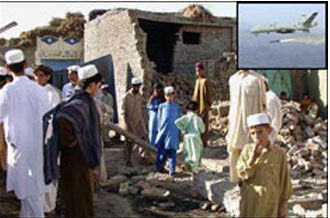 Eight NATO troops killed as Afghan pilot opens fire