Pages

Monday, March 15, 2021

Shrines and Devotees in Kashmir


By Mushtaq Ul Haq Ahmad Sikander, New Age Islam

15 March 2021

Kashmir is a hotbed of rumours. We hear them every day, believe in them, later circulate them, ultimately they become a part of our folklore. Later historians document them as oral history that helps them construct the past. Even about religious personalities we have invented, circulated and reinforced the miracles that have no documentary evidence or religious basis. Although Kashmir is not an exception, religious personalities and shrines all have share of such miracles attributed to them. It includes Tigers paying a visit, the Pir coming to the rescue of his/her disciples in times of need and Pir being omnipresent in different places at the same time.
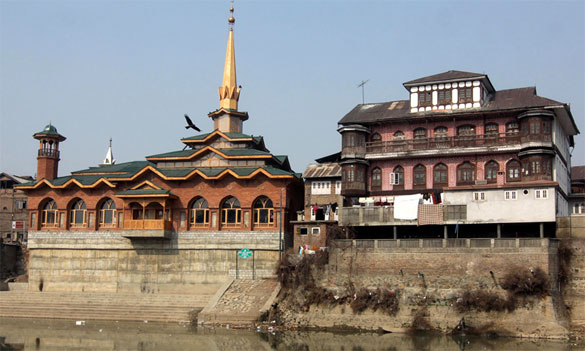
 

The shrine of Hazrat Syed Sharif-ud-Din Abdur Rehman, aka Bulbul Shah, the first Muslim Sufi saint from Central Asia to have arrived in Kashmir in 1324 AD, is located in downtown Srinagar. This shrine was recently renovated .Photo: Bee, Bilal.

----

So these myths become unquestionable and with time they achieve a divine status. Even Ulama do not dare to question the validity and authenticity of such ‘miracles.’ So once divine sanctity is granted to such folklore stories, the life, legacy and works of these saints become non pragmatic to be followed by lesser mortals like us. The element of divinity renders it impossible for anyone to follow their message and legacy. Their teachings are overshadowed by their miracles so the real message of these saints is lost.

Keeping this context in mind I decided to undertake an ethnographic study of the devotees who visit the shrines and talk to them about their beliefs and reasons for visiting the shrines. The results were quite astonishing. The study comprises of ethnography of devotees of two shrines in Srinagar spanning over a period of few months.

The average devotee is not aware about the details, biography or even the branch (Silsila) to which the dead saint belonged. Yes, few details of miracles are certainly known to them. Women devotees lagged far behind the male counterparts when it came to the nuances of knowledge about the saint. Some of them only know the common name of the saint, they were not even aware about his full name. When asked about the reason for their visit, they said that the saint has miraculous powers to heal, grant their wishes, get them out of trouble and intercede on their behalf in the court of Allah.
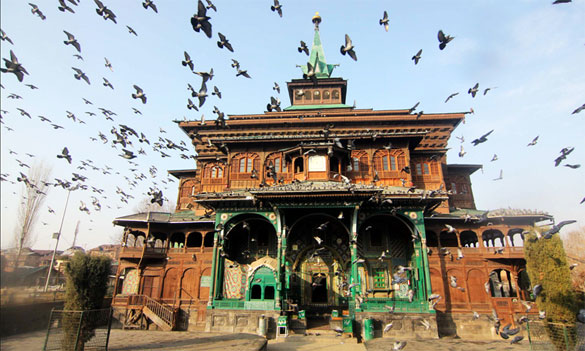
 

The shrine of Mir Syed Ali Hamadani

-----

Rarely did I find a devotee who informed me that they come to pray in the shrine as it is a place of reverence and Allah has blessed this saint so praying in this space has more chances of acceptance. Among these rare devotees very few were hopeful of the intercession by the saint in the hereafter.

In agricultural societies we witness more devotion towards saints and shrines as the produce is mostly dependent on natural means of irrigation, rain, snow etc. So when I enquired from the devotees who were demographically rural based they certainly would not share the intense deep desires and demands, but usually informed me that they asked for good production, healing of someone sick in their family and government employment for their children. These three domains are for the welfare state to cater but in Kashmir due to non availability of best irrigation practices, healthcare system and bleak opportunities of employment they are demanded from dead saints not from the government. It depicts deep reverence and fetish for the dead.

Fetish maybe a strong term but if we read the biographies of these saints, they were ridiculed, humiliated, turned down and some like Nund Rishi or Alamdar e Kashmir also incarcerated for their views by the kings on the insistence of clergy (who in Kashmiri are known as Mallas) a term used by Nund Rishi and his predecessor Lal Ded to describe the religious class who exploit religion, vulnerabilities of common masses, their reverence for saints and rituals while amassing wealth for themselves. Now the same clergy against whom these saints had initiated a Jihad in their life time have appropriated them. But when I talked to the devotees about the exploitation of this clergy class who has appropriated the teachings of the saint, held him captive and now are demanding ransom in his name, they were dumbfounded.

In fact some justified their actions because they are taking care of the shrine so they deserved what they were getting. It was indeed a startling revelation about the power of clergy, although Sunni Islam boasts about having no basis for clergy but the lived reality is that clergy is quite vibrant. I asked from the administrators and Sajada Nisheens of these shrines whether they do spend the money collected as donations in the shrine as charity. They avoided answering my queries. Covid pandemic exposed the clergy and shrines, their role as parasites sucking off the money from poor masses while amassing wealth in the name of religion.

J&K Waqf Board that controls these shrines has been a den of corruption and subsequent governments of National Conference and Peoples Democratic party alongwith Congress have ruined this institution by siphoning off the revenue of this institution and inducted their party workers on different posts, thus resulting in dwindling revenues of the already starved Waqf fiancés. Further the distinction of Sufis from clergy was that they mostly stayed away from the corridors of power. In fact most of them considered it quite inappropriate akin to blasphemy to visit the courts of kings or government officials. But now those occupying the positions of prestige in these shrines boldly invite and revere corrupt [politicians, immoral businessmen and even criminals and even organize their Dastarbandi (placing a turban on their heads as a mark of reverence) in the holy premises of these shrines. It is because of the conduct of such clergy and alleged progeny of these saints that real teachings of these saints are retrograded into oblivion.
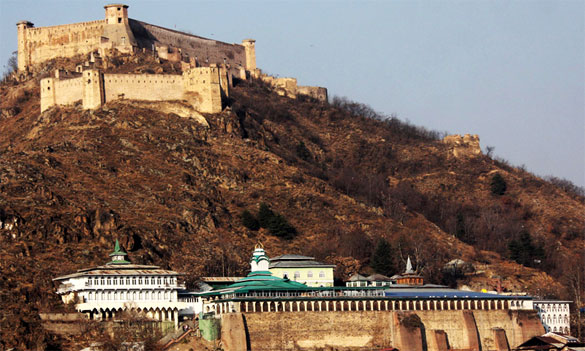
 

The shrine of Makhdoom Sheikh Hamzah, a Muslim Sufi scholar and saint, is placed below the attractive Mughal Fort, on the Hari Parbat hill (Koh-i-Maran). It is a structure with many pillars, a rare example of Mughal architecture. Photo: Bee, Bilal.

------

Shrines as institutions of pluralism, gender neutrality and egalitarianism have witnessed a change too. Now small number of non-Muslims visit shrines, so do many Muslims abhor it as they consider it to be synonymous with Shirk (associating partners with Allah). This class being influenced by the Salafi movement concludes that whosoever visits shrines is committing Shirk as they think that they are seeking help from the dead saint instead of Allah. However that certainly is not true for all devotees. It is what I found too during my study.

Further the exploitation and lavish life of the clergy and administration associated with the shrines is not true for each and every shrine, as income depends on the number of visiting devotees that varies for each shrine. So many associated with shrines do not have the privilege of a lavish life. The shrines as institutions of gender equality, pluralism, dialogue and egalitarianism need to be revived keeping in context the teachings, message, life and legacy of the saints. The Sufi saints who devoted their whole lives for the spread of Islam, values of Peace, love and humanity need to be revisited and celebrated not only on few specific days but daily in our lives that would help develop a culture of love and tolerance free from exploitation. 

-----

M.H.A.Sikander is Writer-Activist based in Srinagar, Kashmir .

URL:    

New Age Islam, Islam Online, Islamic Website, African Muslim News, Arab World News, South Asia News, Indian Muslim News, World Muslim News, Women in Islam, Islamic Feminism, Arab Women, Women In Arab, Islamophobia in America, Muslim Women in West, Islam Women and Feminism

Thursday, March 11, 2021

Swiss Vote for Ban on Burqa and ‘Indian Islam’: A Progressive Indian Muslim Outlook


By Ghulam Rasool Dehlvi, New Age Islam

11 March 2021

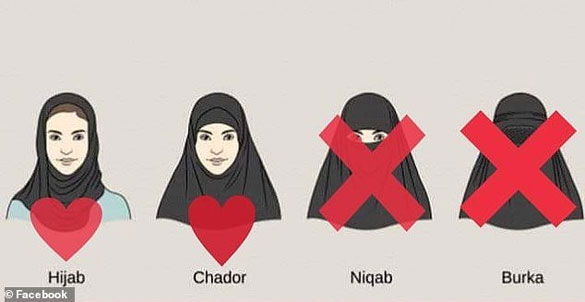
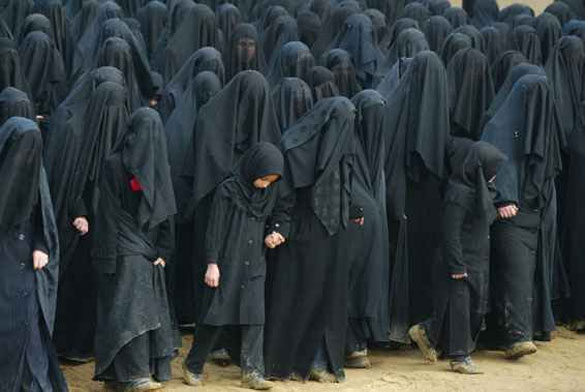
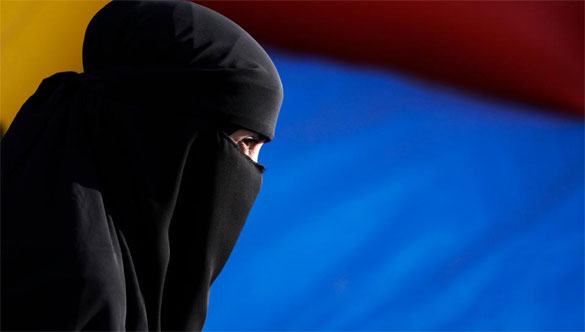
Swiss voters on Sunday narrowly backed a ban on full face Burqa for the Muslim women. An official referendum has shown that in Switzerland—a country which is actually one of the first modern-style democracies in the world— around 51.21 percent of voters and a majority of federal Switzerland’s cantons are against the wearing of the Burqa in public places. Some 1,426,992 voters backed the ban, while 1,359,621 were against, on a 50.8 percent turnout.  According to reports, Switzerland will only allow women to wear it inside their respective places of worship and for “native customs”.  It was, in fact, the Swiss People’s Party (SVP) which launched the proposal of the Burqa ban in public places. It has earlier held some processions and put up posters that featured a woman in a black Burqa/Niqab with captions like “end extremism” and “fight against radical Islam” etc.


This writer has a short-lived experience in certain parts of Switzerland. To utter surprise, the Burqa-clad women in Switzerland are hardly seen anywhere, except in some parts of Zurich, Lausanne and Saint Gallen where Muslims from Turkey, Pakistan, and several Arab countries are staying as migrants and refugees. Given that only five percent of the total Swiss population, which would be around 86 lakh people, are Muslims, mostly originating from Turkey, Bosnia, Kosovo and former Yugoslavia which themselves hardly ever had a ‘Burqa culture’, it is then no wonder. According to research by the University of Lucerne, almost no Muslim woman in Switzerland wears a Burqa or any full-face veil. The University of Lucerne has found in its recent study that the Burqa, Niqab or full-face veil is hardly ever worn in Switzerland, not to speak for advocating it. Even in the religious places like the Turkish Sunni mosques in Zurich, Berne or Geneva, or the Shia places of worship in Schlieren and Saint Gallen, fewer women wear the Burqa or full-face cover, as this writer has seen by himself. Then what is the reason behind the sudden stronger reactions of Muslim communities in Switzerland condemned the campaign against the Swiss ban on Burqa, describing the day it was discussed in the Swiss parliament as a “black day” for Muslims?

Tellingly, the newly-founded Islamic Central Council of Switzerland and the Association of Islamic Organisations in Zurich (VIOZ), the largest cantonal Islamic umbrella organization in Switzerland have expressed great concern over the Swiss vote that, they say, has “proved an increase in Islamophobia in Switzerland since the ban on minarets in 2009.” It is worth mentioning that the Swiss citizens, both Christians, agnostics and atheists, had voted on the proposal to ban the building of minarets when the SVP claimed the building was a ‘sign of Islamisation’. In the wake of all this, a similar discourse on the whole issue has been renewed in India’s Islamic circles. Dr. Zeenat Shaukat Ali, a Prof. of Islamic studies and Saira Shah Halim, social and women rights activist, Jawed Anand and the Indian Muslim Secular Democracy (IMSD) have all weighed in. They propound that the full-face veil is not mentioned in the Qur’an, and that only head covering is Islamic or Qur’anic, and not the covering of full face for women. Also, in the earliest period of Islam, that’s is the Prophetic Age, called Ahd-e-Risalat, women were not clad in Burqa anywhere in the Arabian Peninsula.


 Regardless of the actual reasons why many Swiss voters support the Burqa ban in their country, the fact remains that the Arabic-style Abaaya or the post-1979 Islamic Revolution Iranian Hijab or Niqab, which later transformed into what we earlier called “Burqa” and now “Burkha” in the Indian subcontinent, are not actually 'Islamic'. All these have been imposed on Muslim women in different periods to pursue the pan-Islamic political ends. Hence, they can be, at best, seen today as different regional or ‘cultural’ practices in Muslim societies, and not as part of religion or as an essential part of the Islamic code of conduct. More significantly, it cannot be justified or juxtaposed with religion as one’s ‘personal choice’ or ‘freedom of religion’ under the large ambit of human rights in the modern democratic countries, from France, Switzerland to India.

In fact, some Muslim countries of higher Islamic authorities like Egypt, the cradle of Sunni Islam’s largest seminary Al-Azhar Sharif, Tunisia, which is a new regional epicentre of the evolving neo-Salafist theology, Azerbaijan, a progressive and modern Muslim nation in Central Asia, have either banned or introduced strict laws against the full face-coverings. Turkey, which had a little stricter law against the full-face veil, especially the Saudi-Arabic style, has only abrogated it now under the current regime of the aspiring global Islamist leader, Rajab Tayyab Erdogan. In Egypt, the full-face covering has been seen as part of the anti-regime political Islamist expression of resistance. The 1996 Fatwa issued by the then Grand Mufti of Egypt and Sheikh Al-Azhar, Sayyid Tantawi categorically stated that the full-face veil was not required in Islam, and has not been mandated by the Qur’anic verses related to Hijab or Jilbab.

But ironically, in India, most traditionalist Islamic theologians and Muftis are less aware of these established Traditions and Texts (Nusus) and are more abreast of the 18th century Fatwa documents like Fatawa e Alamgiriyya (compiled at the order of Aurangzeb), and Fatawa e Razawiyyah (of Maulana Ahmad Raza Khan). The reason is that the Mufti-making ‘ifta’ curriculum, which is around a 2 to 5-year course in the Sunni Madrasas has become what they themselves call 'Sho'aba e Waqt Guzari' (a department for ‘time pass’).


But on the other hand, the established theologians of Islam around the world have debunked the untenable theological justifications around the full-face veil of all forms. Busting the myth of Burqa/Burkha ʻAbd al-Ḥalīm Abū Shuqqah has elucidated in his well-researched Arabic book titled as, “Freedom of Women in the Prophetic Age” (تحرير المرأة في عصر الرسالة) that there was actually no imposition of the full-face veil in times of Prophet Muhammad (pbuh). He has ample proof from the Qur’an and authentic Prophetic Traditions (Sahih Ahadith) to buttress this point.

A rather radically new and thought-provoking narrative is that the un-Qur’anic patriarchy brutalizes the Muslim men more than their women, as it leads to the de-humanization of the whole community, especially the men as ‘guardians’ or ‘controllers’ (Qawwamun) of the Muslim society.  All in all, an emerging moderate Muslim thinking is that the Burqa culture in the Indian setting is part of deep-rooted religious patriarchy which has its origins in the Constantinople Christianity, the Byzantine theology or more conventionally and systematically in the Jewish Hassidic community, an ultra-orthodox sect which spread in the Europe with its birth in Israel.

The latest write-ups by Ghazala Wahhab, and excerpts from her book “Born a Muslim: Some Truths about Islam in India” as reproduced by New Age Islam have also sought some intellectual contestations on the related issues.  Although there’s nothing new in Wahab’s book, it has been placed among the books of the week, which reinforces a new narrative that the “progressive” Indian Muslims were Communists or Leftists though steeped in Islamic culture by way of mannerisms and attire, and thus she singles out an Islamic feministic outlook advocating for a complete gender equality in Islam. But then she takes the position of a traditionalist Muslim when it comes to commenting on the Prophet's first wife Hazrat Khadija. Wahab writes: “How appalling it is then that this astonishing and unparalleled story of a remarkable medieval woman has been relegated to the footnotes of Islamic history, and is remembered only for her piety and devotion to her husband”.

In fact, what we need to address is the misplaced religiosity attached to the regional Arabic, Turkish or Iranian cultural and identity expressions disguised as 'Islamic' in the Indian subcontinent. Those who seek to revive the 'actual', 'authentic' or 'puritan' Islam in India--be they Salafis, Deobandis, Shias or some of the Barelwis—they all need to look at how Islam was best practiced in India as an indigenous, vernacularized faith tradition which accentuated and enhanced the overall image and socio-economic status of Muslims in different periods. But the current state of 'purified' Indian Muslims, largely churned out from the ultra-orthodox Islamist ghettos, traditionalist madrasas and Maktabs from Kashmir to Kerala are indicative of their religious, cultural and socio-economic decay. We need to trace the syncretic Indian Islam’s history from the 7th century Arabia to how it arrived in India through trade routes and a great deal of cultural interactions and inter-connections which evolved through the centuries to reach its present state—which we term today as ‘Indian Islam’.

As far the attempt to link the Hijab/Niqab to Radical Islam, it is untenable and cannot be entertained as a logical assertion. In fact, such juxtaposition is uncalled for and is highly undesirable especially in the times of the growing 'Islamophobia'. While at the same time, Indian Muslim women and especially those educated in modern central universities like Jamia Millia Islamia, AMU and JNU must understand that the full-face veil is not a part of the established Islamic cultural ethos. And these institutions were not prone to the Burqa culture in their formative periods, but rather they were cradles of the best indigenous Islamic practices.

They have existed long before the advent of radical Islam in the country. Burqa is much more based on an imposed foreign culture and not on religion. We must understand that the practice has not really existed in what we call the 'golden age' of Islam. It does have its origins in the Hellenistic and Byzantine Empire, and in some parts of Persia but not in the Hijaz of present-day Saudi Arabia, which is the birth-place of Islam. In Iran, the Burqa culture among Shias gained momentum only after the 1970s revolution of Imam Khomeini which gave rise to the global Islamic identity politics and Islamist nationalism. If we look into the existing practices of nearly all North African and Central Asian Muslim countries, they have had some strict laws to curb this identity politics of whatever origin. While in Morocco, the hijab has been seen as a sign of political fundamentalism against the secular government, so is the case in Azerbaijan since 2010 and in Tunisia since 1980. It was neither favourably looked up as part of freedom of religious expressions in the historic times of Turkey. In the largest democracy like India, a clearer message should percolate down as far as the Muslim women identity crisis is concerned. And of course, Hijab or Jilbab should not be seen as stereotypical thinking. Muslim girls in Hijab, without advocating for the Burqa, have excelled in different lawful pursuits in the country. 

 -------

Regular Columnist with Newageislam.com, Ghulam Rasool Dehlvi is a classical Islamic scholar and English-Arabic-Urdu writer. He has graduated from a leading Islamic seminary of India, acquired Diploma in Qur'anic sciences and Certificate in Uloom ul Hadith from Al-Azhar Institute of Islamic Studies. Presently, he is pursuing his PhD in Jamia Millia Islamia, New Delhi

URL: 

New Age Islam, Islam Online, Islamic Website, African Muslim News, Arab World News, South Asia News, Indian Muslim News, World Muslim News, Women in Islam, Islamic Feminism, Arab Women, Women In Arab, Islamophobia in America, Muslim Women in West, Islam Women and Feminism

Wednesday, March 10, 2021

It Is All Right To Offer Courses On Gita But What About Other Religions?


By Arshad Alam, New Age Islam

10 March 2021

The National Institute of Open Schooling (NIOS) has recently suggested the introduction of Gita and other religious texts in madrasas. This has led to severe criticism from different quarters. Sections of the ‘secular’ press have tried to understand this step as an imposition of ‘alien’ religious values on Islamic madrasas. Muslim clerics similarly have declared that they will oppose any such move on part of the government. Others have pointed out that there may be nothing wrong in teaching the Gita to madrasa students but then they are of the opinion that the Quran should also be taught in Hindu religious institutions like the Gurukuls. But as it often happens, between the polarised positions of those opposing the move and those supporting it, the nuance often gets lost.

------------------------------------------------------------------------------

Also Read: Madrasa Education is a Clear Violation of the Human Rights of Children: Sultan Shahin asks UNHRC to make Muslim Countries Stick to their Pious Declarations

------------------------------------------------------------------------------

First things first. The proposal to introduce Hindu religious texts has come from the NIOS, which is an autonomous body within the HRD ministry and thus cannot be said to be directly coming from the government as it is made out to be. Through the Scheme for Providing Quality Education in Madrasas (SPQEM), the NIOS has already enrolled fifty thousand students from around hundred madrasas all over the country. For madrasa students, the NIOS is beneficial as they are able to pursue courses and programs which are not available in their own institutions. There is demand from within the madrasas to expand the reach of NIOS and get their students accredited to it. In fact, it was the Sachar Committee Report, which for the first time, had suggested that NIOS could be one of the ways of mainstreaming madrasas. The open schooling system offers a bouquet of subjects and students are free to choose from the many courses.

The flexibility that NIOS system gives is not possible within the formal schooling system. Within the open schooling system, it is the discretion of the learner to choose any subject or a combination of them. Thus it needs to be clarified that NIOS has just suggested that courses on Hindu religious themes, and many others, be introduced to madrasa students. It is just a proposal and not an order as it is made out to be. The very nature of NIOS would mean that these courses will not be imposed on students but that the latter would be free to choose them only if they want.

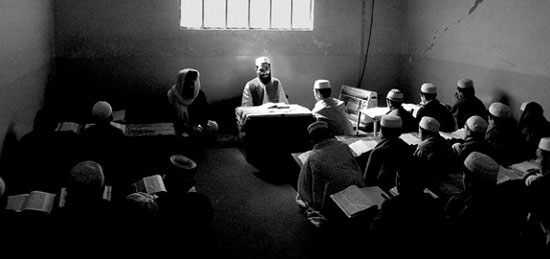
Representational Photo

-----

It is important to understand that there are two very different kinds of madrasas which operate in the country. The more numerous ones are those who are outside the control of various state madrasa boards and hence will not likely even consider the NIOS proposal. The NIOS proposal might be entertained by board controlled madrasas but even here just a few thousands do accredited courses from NIOS. Thus the overall number of madrasa students who will be impacted if such a proposal gets considered will be a minor fraction of the total strength. The Muslim clergy, being fully aware of these details, are opposing the proposal just for the political optics of it.

------------------------------------------------------------------------------

Also Read: RESTRUCTURING MADRASA EDUCATION: Muslim Opponents of India’s 'Right of Children to Free and Compulsory Education Act' are Enemies of Indian Muslims

------------------------------------------------------------------------------

The more important question that we need to ask is what is the problem if Gita and texts of other religions are to be taught in madrasas? Madrasa students, especially those who study in independent seminaries, are normally insular when it comes to knowledge about other religions. The pedagogy has become so ossified that they do not even have contemporary knowledge of the Muslim world. Most of their energy is spent on refuting what they consider ‘erroneous’ interpretations of Islam. Thus an average Barelwi student learns more about how to refute the Deobandi rather than learning about Islam in contemporary contexts. Some madrasas, in higher classes, have courses on ‘comparative religion’ but then the emphasis here also is about falsifying other religions rather than making any attempt to comprehend them. A little exposure to Hindu religious traditions will only do them good in the long run.

However, NIOS is utilised by many other sections of students as well, not just madrasas. Students of different religious communities, not just Muslims, access their courses. So it is rather intriguing why only texts of one religion is being deemed fit to be offered as pedagogical material. By the same logic, why should the teaching of Quran and Bible not be offered by NIOS? Part of the reason emanates from one of the core objectives of the New Education Policy which lays emphasis on teaching of Indian culture and civilization. While the objective is laudable, the policy makers forget that Indian culture is not just about Hinduism but rather is the outgrowth of contributions from various religions and traditions. Excluding non-Hindu texts, even at the level of proposal, certainly adds up to being discriminatory to other faiths. If the objective of the NIOS was to enhance religious pluralism amongst students, then by limiting this exercise to introducing Hindu religious texts to Muslims, that objective seems to have failed even before it started.

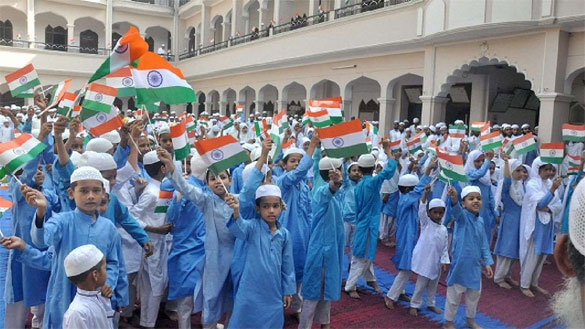
Representational Photo

-----

In fact, Hinduism, being the dominant religion in the country, is accessible to all through various other mediums. Ramayana and Mahabharata were consumed by millions of Muslims and Christians through the medium of television. As such, minority religious groups already have some Knowledge of the Hindu religious faith. The same, however, cannot be said about a majority of Hindus, who, no matter what ideology they belong to, happen to know very little about Islam or Christianity. One of the reasons why there are fantastic stereotypes about Islam is simply because there is not enough understanding about it within the majority community. If there was ever a need to teach religious subjects in this country, they should be targeted at the majority population. The NIOS will do well to design courses with such an objective in mind which will only complement its efforts to teach the Gita to madrasa students.

-----

Arshad Alam is a columnist with NewAgeIslam.com                   

URL:   https://www.newageislam.com/interfaith-dialogue/arshad-alam-new-age-islam/it-is-all-right-to-offer-courses-on-gita-but-what-about-other-religions/d/124508


New Age Islam, Islam Online, Islamic Website, African Muslim News, Arab World News, South Asia News, Indian Muslim News, World Muslim News, Women in Islam, Islamic Feminism, Arab Women, Women In Arab, Islamophobia in America, Muslim Women in West, Islam Women and Feminism

Tuesday, March 9, 2021

Father, Rabbi, Maulana and Brahmin: How Priests Became God


By S. Arshad, New Age Islam

9 March 2021

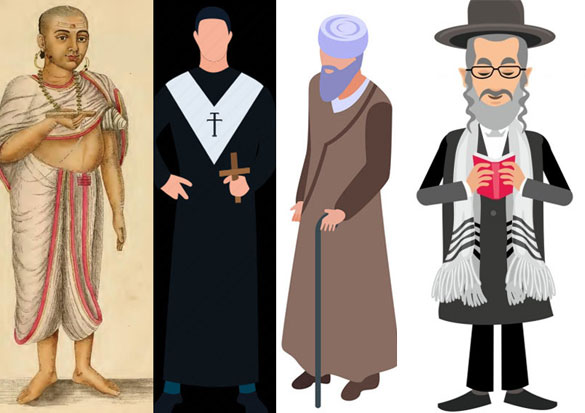
Religious heads or priests assume an important place in all the major religions of the world. They are responsible for the smooth running of religious places --- mosques, churches, temples, synagogues etc – along with guiding the followers of their respective religions in religious matters. However, over time, this section of the community became powerful and assumed centre stage in their respective communities. They possess the theoretical and practical knowledge of their respective religions and are considered an authority in religious matters. Therefore, Maulana in Muslim community, Father (or church father) in Christian community, Rabbi in Jewish community and Brahmin in Hindu religious community hold an important position in their respective religious societies.

Brahmin, Priest, Maulana and Rabbi

-----

However, the concept of clergy in these societies (except in Hinduism) is not supported by their respective scriptures – the holy Quran, the holy Bible and the holy Torah. Only in Chhandogya Upanishad, the Brahmins have been granted a special status. The devotees are expected not to speak ill of the Brahmins.

The most striking aspect of the titles Maulana, Rabbi, Father and Brahmin conferred on the religious heads is that they are in fact used by the Holy Scriptures for God and not for the religious heads or priests. The priests adopted these titles to suggest that they were next to God and so very important and revered persons.

For example, the term Maulana which is used for religious heads or priests of Muslims in the Indian sub-continent (India, Pakistan, Bangladesh, Nepal and Sri Lanka). A Maulana is a religious scholar having graduated from a madrasa and has authority on Shariah matters. But the literal meaning of the word Maulana is our God or our Lord. (Maulana). The word occurs in the Quran on two occasions (2:286 and 9:51). The word is not used in the Arab world and in Iran it is used only to mean the philosopher Rumi (Maulana Rum). In some African countries, the word means any scholar or secular public figure. How and when the word meaning God came to be used by Muslims in the Indian sub-continent for religious heads is a matter of research.

The word Rabbi is used for religious heads or priests in Judaism.  A Rabbi has the theoretical knowledge of Judaic religious texts like Talmud and is responsible for the services in a Synagogue. But the word Rabbi does not find a place in the Hebrew Bible. It was used for the Talmudic era religious teachers who would assemble to codify Judaism’s written and oral laws. The word rabbi is derived from the Hebrew word rav meaning the great one or master. In later years, that is from the 1ST century CE, the word has been used for religious heads of Jews. The word in Arabic means my God or my Lord. Therefore, the Rabbis adopted a word that literally meant my God.

The Christian priests are called church father or generally, Father. In Trinitarian Christianity, God is called the Father. He is God the Father, God the son and God the Holy Spirit. In many verses in the New Testament, God describes himself as Father to the humankind. In the early era of Christianity, from the 1st century to the 8th century CE, influential Christian theologians and writers who established intellectual and doctrinal foundations of Christianity were called Church Fathers.  But the church priests of the later era also used the term for themselves because it gave them a sense of superiority in their community. Thus, they used a word for themselves which God used for himself in the Bible.

In Hinduism, the temple priests are called Brahmin but the word is pronounced a little differently from the same word meaning the formless attributeless God Brahmin. Brahmin meaning the priest is pronounced as Brahmin with a long “A”. In the Vedas, Brahmin is the creative principle, or the Supreme Being which creates, destroys and sustains the universe. The Vedas and the Upanishads use the word Brahmin for the Supreme Being or the indwelling soul of the material world a number of times. However, as mentioned earlier, Chhandogya Upanishad has recognized the institution of Brahminhood and asks devotees to be respectful of Brahmins.

The word Maulana among Muslims seems to be inspired by the Judaic and Christian traditions of adopting the word meant for God though Muslims, particularly in the Indian sub-continent talk ad nauseam of Jewish conspiracies to corrupt Muslim minds and their beliefs. 

----

S. Arshad is a columnist with NewAgeIslam.com

URL:  

New Age Islam, Islam Online, Islamic Website, African Muslim News, Arab World News, South Asia News, Indian Muslim News, World Muslim News, Women in Islam, Islamic Feminism, Arab Women, Women In Arab, Islamophobia in America, Muslim Women in West, Islam Women and Feminism