By Naseer Ahmed, New Age Islam
24 Feb,2021
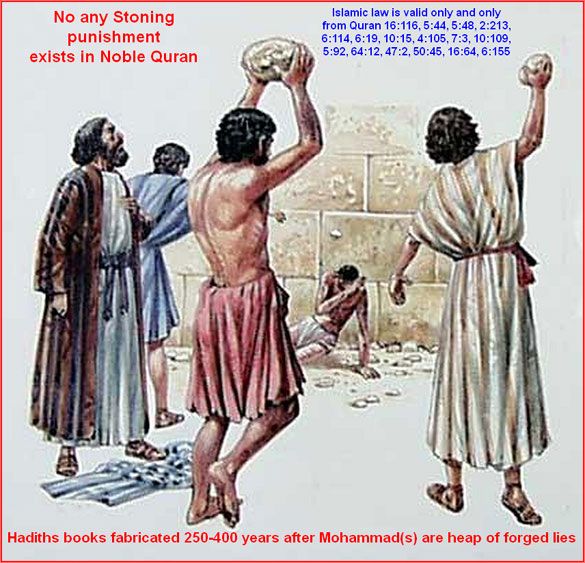
The law on adultery in the Quran is the only law laid down in the Quran prescribing a mandatory punishment of a hundred stripes for a proven case. The punishment cannot be increased, decreased, or waived. Every other law, while detailing the punishment, allows for decreasing or even waiving it. The law on adultery is also the most detailed law prescribing the strength of the evidence required to establish the crime/sin as four unimpeachable eye witnesses to the act - a near impossibility, unless, the persons involved are brazen and open in committing the crime in a public place with many witnesses.
(24:2) The woman and the man guilty of adultery or fornication,- flog each of them with a hundred stripes: Let not compassion move you in their case, in a matter prescribed by Allah, if ye believe in Allah and the Last Day: and let a party of the Believers witness their punishment.
..........................
Also Read: Ahadith (plural of Hadith) That Question Practice of Stoning the Adulterers
..........................
The difference between sin and crime is that sin is against Allah while crime is against a human being or the society. A crime is also a sin while the reverse is not always so. A sin is punishable in the Hereafter and a crime in this world, and if not expiated, in the Hereafter as well.
Associating partners with Allah is the most heinous sin but not a crime. Going by the punishment for adultery and the detailed verses on the subject, adultery is considered as the most heinous crime in Islam - more heinous than murder since a murder may avert the death punishment by paying compensation to the family of the slain if they are willing to accept the same. Why is this so? Why adultery is considered the most heinous of crimes in Islam? Logically, it can be considered the most heinous of crimes only if it causes the greatest damage to the person(s) wronged by it and/or those guilty of it, and/or has the greatest potential to corrupt the society if exemplary punishment is not given. Adultery is considered a wrong in Islam that cannot be righted through paying compensation or a fine and must be punished in an exemplary manner to discourage others from indulging in the same.
To make sense of the rigid law on adultery in Islam in a world where consensual sex has been decriminalised and become open and common place, is not easy, except for a few. The Islamic law is unacceptable to most people who think that it is natural to enjoy unrestrained sexual freedom and that the people are mature enough to navigate through the turbulence caused by such freedom.
..........................
..........................
The Islamic law on adultery applies only to its Muslim population even in an Islamic country, and not to its non-Muslim population. Islam does not impose its sexual morality on those who do not follow Islam. The Quran recognises the diversity in behaviour, norms, attitudes and beliefs governing sexual behaviour. There are a number of tribal societies even today, in which a woman cohabits with many men. According to the beliefs of such people, a child is not born from the sperm of a single man, but from the accumulation of sperm in a woman’s womb. A woman will therefore try to have sex with many men, especially when she is pregnant, so that she can collect enough semen in her body to produce the child. In such a society, it is virtuous women who sleep with many men. The behaviour of the people in such a society is because of their false beliefs and not from sexual promiscuity. It would be pointless to impose Islamic sexual norms on such a society and the Quranic law on adultery clearly exempts from its purview societies in which adultery as defined by Islam is not a crime. Adultery is therefore unlike other crimes such as theft, which are universally held to be worthy of being punished, and not tolerated.
We must however recognise that monogamous relationships and nuclear families are the norm in the vast majority of cultures and men and women tend to be very possessive of their partners and children. It is sexual promiscuity that drives people to cheating on their partners in these societies. Even so, consensual adult sex has been decriminalised in much of the world.
Adultery has become common and widespread among a vast majority of the population and takes various forms such as single-encounters or one night stands, social sex or “friends with benefits, booty calls, recreational sex, hooking up for sex which has replaced dating. However, even in such a society, where on an average a person during his/her lifetime has many sexual partners, two persons in a relationship (without even being married to each other), expect their partner to remain faithful to them. If any one of the partners so much as dallies in a casual romantic encounter outside the relationship, the matter is considered serious enough to break the relationship, unless both are swingers and consensually open to recreational sex. Lack of faithfulness in a relationship therefore continues to be a serious issue leading to breaking of the relationship and crimes of passion. A break-up is always traumatic for both the partners and leaves its toll. A society in which adultery is common is a stressful society where people look upon each other with suspicion and where the trust between partners does not last and gets broken. It is a recipe for mental illnesses on a pandemic scale and this is what we find to be true. Matters have deteriorated to such an extent that sex is no longer a culmination of love and desire for intimacy, but a bodily function outside of a relationship, as it exists between a sex worker and his/her client, except that this is now between two consenting adults neither of whom is a sex worker. This is the hook-up generation. We can expect mental illnesses in the society to intensify, suicide and crime rates to go up.
..........................
Also Read: Marriage Is a Civil Contract — Adultery or Divorce Should Have Only Civil Consequences
..........................
The Islamic law on adultery may sound anachronistic in this age, but the fact remains that every living being values love, intimacy, stability, and faithfulness in a relationship. The infidelities that characterise modern relationships, the high rates of divorce, and the plethora of mental problems from which the children and adults suffer as a result of the broken relationships, should make every society crave for the Islamic norms. It is however almost impossible for a non-religious society to gain widespread support for laws that punish any consensual act between adults. All our morality comes from religion and there is widespread consensus in the society to frame “moral” laws covering non-consensual acts such as theft, murder, rape etc., but not for acts that are consensual.
The most heinous crime in Islam will therefore remain not a crime in non-religious societies. Muslims can remain in the pale of Islam by accepting and following Islamic norms or leave Muslim society and join any other society where these norms are loose and not observed. The Quran is very clear on the subject warning a Muslim from marrying an adulterer and an adulterous Muslim from marrying a non-adulterous Muslim.
The wider context to the law on adultery
There is a wider context to the law of adultery in Islam. It would appear that no morality is possible without sexual morality. Adam and Hawwa were expelled from the Heavens because they indulged in an act that made them aware of all their shame and the need to cover it.
(20:117) Then We said: "O Adam! Verily, this (Satan) is an enemy to thee and thy wife: so let him not get you both out of the Garden, so that thou art landed in misery.(118) "There is therein (enough provision) for thee not to go hungry nor to go naked,(119) "Nor to suffer from thirst, nor from the sun´s heat."(120) But Satan whispered evil to him: he said, "O Adam! shall I lead thee to the Tree of Eternity and to a kingdom that never decays?"(121) In the result, they both ate of the tree, and so their nakedness appeared to them: they began to sew together, for their covering, leaves from the Garden: thus did Adam disobey his Lord, and allow himself to be seduced.
Another version of the story:
(7:20) Then began Satan to whisper suggestions to them, bringing openly before their minds all their shame that was hidden from them (before): he said: "Your Lord only forbade you this tree, lest ye should become angels or such beings as live forever."(21) And he swore to them both, that he was their sincere adviser.(22) So by deceit he brought about their fall: when they tasted of the tree, their shame became manifest to them, and they began to sew together the leaves of the garden over their bodies. And their Lord called unto them: "Did I not forbid you that tree, and tell you that Satan was an avowed enemy unto you?"(23) They said: "Our Lord! We have wronged our own souls: If thou forgive us not and bestow not upon us Thy Mercy, we shall certainly be lost."
Our genes live through our children forever. The verses above perhaps euphemistically mean that Satan enticed Adam and his wife to indulge in the sexual act that made them aware of the sexual nature of their bodies.
Verses covering sexual modesty
(7:26) O ye Children of Adam! We have bestowed raiment upon you to cover your shame, as well as to be an adornment to you. But the raiment of righteousness (taqwa), - that is the best. Such are among the Signs of Allah, that they may receive admonition! (27) O ye Children of Adam! Let not Satan seduce you, in the same manner as He got your parents out of the Garden, stripping them of their raiment, to expose their shame: for he and his tribe watch you from a position where ye cannot see them: We made the evil ones friends (only) to those without faith.(28) When they do aught that is shameful, they say: "We found our fathers doing so"; and "Allah commanded us thus": Say: "Nay, Allah never commands what is shameful: do ye say of Allah what ye know not?"(29) Say: "My Lord hath commanded justice; and that ye set your whole selves (to Him) at every time and place of prayer, and call upon Him, making your devotion sincere as in His sight: such as He created you in the beginning, so shall ye return."(30) Some He hath guided: Others have (by their choice) deserved the loss of their way; in that they took the evil ones, in preference to Allah, for their friends and protectors, and think that they receive guidance.
..........................
Also Read: Flogging of Women for Sex Outside Marriage Stands Brutal and Un-Islamic Today
..........................
Just as raiment covers our shame (body) and is also an adornment, taqwa will be our raiment in the Hereafter which will both adorn us and cover our shame. Those without taqwa will be covered with shame. Taqwa means doing in the best possible manner what Allah enjoins and scrupulously avoiding what Allah forbids.
Spouses are each other’s garment
(2:187) Permitted to you, on the night of the fasts, is the approach to your wives. They are your garments and ye are their garments....
There is no shame between spouses just as there is no shame between us and our garments. Our spouses are our garments keeping us chaste outside the marital relationship while allowing full sexual freedom within the relationship.
Guarding even our gaze
(24:30) Say to the believing men that they should lower their gaze and guard their modesty: that will make for greater purity for them: And Allah is well acquainted with all that they do.
(31) And say to the believing women that they should lower their gaze and guard their modesty; that they should not display their beauty and ornaments except what (must ordinarily) appear thereof; that they should draw their veils over their bosoms and not display their beauty except to their husbands, their fathers, their husband´s fathers, their sons, their husbands´ sons, their brothers or their brothers´ sons, or their sisters´ sons, or their women, or the slaves whom their right hands possess, or male servants free of physical needs, or small children who have no sense of the shame of sex; and that they should not strike their feet in order to draw attention to their hidden ornaments. And O ye Believers! Turn ye all together towards Allah, that ye may attain Bliss.
The path to evil appears to be through loss of shame and begins with Satan stripping us of our raiment or shame. A sense of shame is essential to avoid every evil and without it a person will easily indulge in every temptation and evil. Morality thus begins with modesty. Without shame, a person will lie, cheat, defraud, steal, rape and give in to every evil impulse and temptation.
Adultery represents the height of evil. Besides being a forbidden sexual act, it is stealing from a rightful partner and deceiving your own partner. It is also betrayal of a solemn trust. It also entails lying and deception to cover up the relationship as long as possible. It is also self-indulgence and yielding to temptation. The harm is not only to the adulterers and their spouses but also to their children and families. When the act becomes public, it has the potential to corrupt society. This is why Islam is for guarding Muslim society from this evil.
..........................
Also Read: Are Hudud Laws In Islam Or Quranic Punishments Barbaric?
..........................
Islamic morality based on Allah’s laws in the Quran is the perfected Deen, best to ensure social justice, happiness, fulfilment, mental and physical health.
(39:18) Those who listen to the Word, and follow it as best as they can: those are the ones whom Allah has guided, and those are the ones endued with understanding.
A frequent contributor to NewAgeIslam.com, Naseer Ahmed is an Engineering graduate from IIT Kanpur and is an independent IT consultant after having served in both the Public and Private sector in responsible positions for over three decades. He has spent years studying Quran in-depth and made seminal contributions to its interpretation.
New Age Islam, Islam Online, Islamic Website, African Muslim News, Arab World News, South Asia News, Indian Muslim News, World Muslim News, Women in Islam, Islamic Feminism, Arab Women, Women In Arab, Islamophobia in America, Muslim Women in West, Islam Women and Feminism
 4:16 AM
 Moderate Islamist here