Pages

Thursday, September 2, 2021

Had Muslims Gone For Universal, Modern Education There Would Have Been Peace in Islamic Societies and the World, Not Terrorism and Militancy, Either Religious or Social


By Arman Neyazi, New Age Islam

2 September 2021

Islam Is a Religion of Peace Promoting Inclusiveness, Therefore, Terrorism Cannot Be A Part Of It

Main Points:

1.    The Muslim world is in a fix on terrorism.

2.    Scholars of Islamic studies, scholars of Islamic social ethics and common Muslims, all are in doldrums, not understanding what is happening with Islam.

3.    In a Muslim country, a  pro- Muslim country or an anti-Muslim country, everyone related to Islam or Muslims is looking for a solution to terrorism.

4.    Education for all is the mantra for all those who are concerned to bring spiritual and social developments to the world.

-----

The Muslim world is in a fix on terrorism. Islam is a religion of peace-promoting inclusiveness, therefore, terrorism cannot be a part of it. Scholars of Islamic studies, scholars of Islamic social ethics and common Muslims, all are in doldrums, not understanding what is happening with Islam. All over the world, be it a Muslim country, a pro- Muslim country or an anti-Muslim country, everyone related to Islam or Muslims is trying to understand the problems engulfing the Muslim world and looking for its solution. It is because the world knows the implications of the problems faced by the Muslims will also impact them.

Muslims of the Asian countries, Pakistan, Bangladesh, India, Sri Lanka, Afghanistan and Maldives are illiterate and poor. They are more concerned about their everyday bread and butter than terrorism. For them the safety of their family as long as they are alive is more important than being surrounded by the horrors of terror, everyday western countries bombing on one pretext or the other. These non-existing Muslims, for the entire civilized and keepers of the human rights western countries, do not matter except on their database. And now the Muslims of these Asian countries, as well as Muslims of the entire world, have accepted the reality that now they have to extinguish the fire of terrorism that has been ignited by the Islam hating communities. Al-Qaeda Boko Haram Afghan Taliban ISIS and Pakistan Taliban or for that matter any other supremacist ideology-driven fascist cannot fight without the sophisticated weapons that they have. Countries that provide them arms and ammunition to spread terror could have financed Muslims to practice education Jihad. But they did not do so. Reasons best known to them.
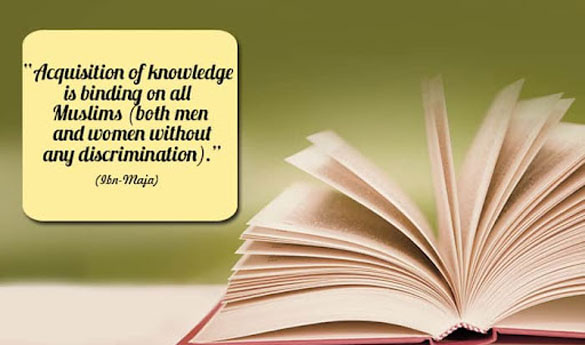
 

Photo courtesy: QuranReading.com

------

Education is being provided and campaigned by the developed world for the people who are loved not for the people who are hated. Hence, Muslims do not find themselves mentioned anywhere in the implementation of educational facilities.  Muslims for the reasons best known to the concerned, are not encouraged to study in the government-run schools and colleges, in various parts of the world, resultantly having no option they opt for madrasas that are run by the 'guardians of one or the other ideologies'. Richest of all the ideological masters have been the Wahhabism followers, so Wahhabi ideology run madrasas with better hostel and mess facilities are the first option for the poor Muslims of India, Pakistan, Bangladesh and Sri Lanka and others. Thus begins Muslim kids training in the ideology that teaches exclusivism and supremacism.

 On the other hand, the powers that be made all efforts to keep Muslims illiterate and got successful in their plan by abusing Muslims for being complacent towards modern education. The plan to let them die for bread, not education was successfully implemented by those who fight for ideology, not humanity.  Now as is said, one reaps what one sows, the knowingly kept illiterate Muslims grew into terrorists and militants in place of scholars and scientists. Do not count those terrorists who are known to be masters of science and technology in this list as they are a pawn in the hands of self-greed and hypocrisy. They are the sophisticated and elegant boss terrorists running the show from air-conditioned villas, not the fighter terrorists, the killing and being killed battlefield terrorists.

Had the mechanically run killing machines been literate, they would not have accepted the ideology of killing fellow beings. Had they at least been taught the Holy Quran and the Prophetic traditions they would have been angel-like people in the service of humanity as doctors and scientists, professors and scholars, aware of what Allah the Most Compassionate says in the Holy Quran: "Whosoever killed a person ... it shall be as if he had killed all mankind" (Al-Maidah:32)

Education will Diminish Terrorism

We, all who are willing to see the end of terrorism from mother earth, need to educate those who are treading the path of destruction, the terrorism. Those who are fighting against western education should know, Prophet Muhammad () says: "Seek knowledge and wisdom, or whatever the vessel from which it flows, you will never be the loser." - Prophet Muhammad (SAW). The said tradition commands the believers to acquire knowledge without discrimination between the Holy Quran, Prophetic traditions, madrasas and English medium schools and universities.

The Muslims should be told that this universe is created by Allah the Most Compassionate so every subject, science, technology, medicine and philosophy along with courses in Islamic studies are His creation, therefore, they must study all and benefit from its knowledge. Muslims should also know about the following traditions of Allah’s Apostle Prophet Muhammad () that says acquiring knowledge is the best form of worship and spreading knowledge is mandatory on every Muslim. Consider the following traditions:

"The best form of worship is the pursuit of knowledge." - Prophet Muhammad ()

"Scholars should endeavour to spread knowledge and provide education to people who have been deprived of it. For, where knowledge is hidden it disappears."

Muslims need to ask the following question asked by someone from the Messenger of Allah Prophet Muhammad () and the answer given by him should be inscribed on the psyche of every Muslim. Prophet () says that it is mandatory for all of us to constantly keep learning from others (irrespective of religion, caste or creed) in whatever subject the knowledge may be available. Consider the following Hadees:

Someone asked the Prophet Muhammad (): "Who is the biggest scholar?" Prophet () replied: "He who is constantly trying to learn from others, for a scholar is ever hungry for more knowledge."
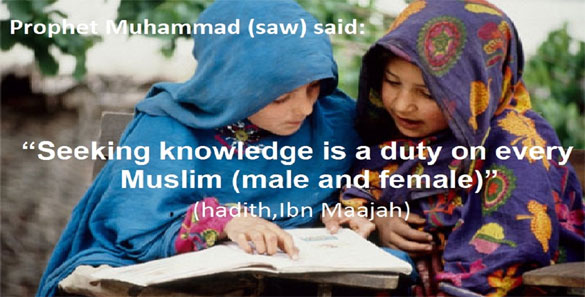


Prophetic Tradition on the Importance of Knowledge

The acquisition of knowledge is compulsory for every Muslim, whether male or female." - Prophet Muhammad ()

"Seek knowledge from the cradle to the grave." - Prophet Muhammad ()

The Messenger of Allah () said: "Whoever takes a path upon which to obtain knowledge, Allah makes the path to Paradise easy for him." (Tirmidhi)

"Contemplating deeply for one hour (with sincerity) is better than 70 years of (mechanical) worship." - Prophet Muhammad ()

"To listen to the words of the learned and to instil unto others the lessons of science is better than religious exercises." - Prophet Muhammad ()

Quranic Verses on Education Being Mandatory

Allah, The All-Wise, All-Knowing constantly describes the benefit of knowledge and the rewards for acquiring knowledge and the obligation of spreading knowledge in His revelations on the Prophet of Islam Hazrat Muhammad Mustafa () in the Holy Quran. Muslim scholars and Quran exegeses are duty-bound to spread education among the Muslims to get them rid of illiteracy that has driven them to poverty and illiteracy.

“Proclaim! (or read!) in the name of thy Lord and Cherisher (Quran, 96:1)

…they could devote themselves to studies in religion, and admonish the people when they return to them, – that thus they (may learn) to guard themselves (against evil)” (Quran, 9:122)

For verily Allah is with those who do right” (Quran, 29:69)

“It is only those who have knowledge among His servants that fear Allah." (Qur’an 35:28)

"And they shall say had we but listened or used reason, we would not be among the inmates of the burning fire." (Quran, 67:10)

Above mentioned Quranic Ayaat should be a lesson for all those who matter in making the world in general and Muslims in particular, study and be a positive source of inclusiveness and ethics of pluralism. Education for all is the mantra for all those who are concerned to bring spiritual and social developments to the world. And let us all raise our hands in unison and ask our Creator to increase our knowledge, "O my Lord! Increase me in knowledge" (20:114) and reward us for spreading knowledge as far as possible.

To fight the terrorism and militancy of every form either religious, ideological or social, the world will have to begin an education Jihad and get rid of all kinds of terror jihads.

And Allah Knows the Best.

---

Arman Neyazi is a columnist with NewAgeIslam.com.

URL:   https://www.newageislam.com/islamic-society/education-terrorism-militancy-religious/d/125305

New Age IslamIslam OnlineIslamic WebsiteAfrican Muslim NewsArab World NewsSouth Asia NewsIndian Muslim NewsWorld Muslim NewsWomen in IslamIslamic FeminismArab WomenWomen In ArabIslamophobia in AmericaMuslim Women in WestIslam Women and Feminism

Islamic Laws, Fatwas And Fiqhi Decisions Drawn From The Sharia For Dealing With Current Scenarios: Flexible Or Immutable?


By Ghulam Ghaus Siddiqi, New Age Islam

2 September 2021

The Goals of Sharia [Maqasid Al-Sharia] Are To Serve All Humanity in Response to Time and Situation Demands

Main Points

1.    According to changes in time and location, rules and judgments based on customs and culture can be adjusted.

2.    Fatwas issued by Ulama in the past can be changed to resolve the present-day difficulties.

3.    The legal regulations were established by the notable authorities, such as Imam Abu Hanifa and others to match the changing circumstances of the time and location.

4.    Ijtihad must be practiced on a regular basis for Sharia to be useful to the Ummah.

5.    Carelessness in formulating a fatwa dealing with interpersonal relationships could result in devastation or even divisiveness.

6.    Fatwas should be based on facts while also emphasizing the principles of social justice and benefits to society.

7.    Before issuing a fatwa, Islamic scholars and "Ulama" must conduct a thorough assessment of current events taking place worldwide.

.....

 “The modification of the rules and judgments based on customs and culture according to the change of time and place,” is one of the most fundamental and significant Islamic maxims addressed by notable scholars of Shari'ah and Principles of Jurisprudence of the many Schools. They have thoroughly discussed it in their books and writings, laying out the rules, splitting it into sections, and applying it to many fields and situations. It is also one of the most significant principles of Islamic law that guides the development of rules and judgments for contemporary concerns in various branches and areas. However, due to rising backwardness in comprehending the Principles of Jurisprudence and Ijtihad, this maxim is frequently disregarded, resulting in a slew of serious difficulties for the common masses.

Theoretical and empirical evidence demonstrates that Islamic law, like Fiqh judgments derived from the Shari'ah, has not remained static or unchanged since its inception, but has responded to, and altered in response to the demands of time and situation. This is especially true when it comes to inter-human social connections (Mu'amalat), which are more affected by the dynamic nature of human life than religious devotion and acts of worship (Ibadat), which are more stable. The reason why rulings based on customs and culture must change as time passes is that needs of people vary with time. A law constructed to be static will impose hardship and constraint. The following is a classic example that is used to exemplify this concept:

During Hazrat Umar Ibn Khattab's Caliphate, the Prophet's (peace be upon him) supporters were anxious about what to do with the land they had acquired in the war after the conquest of Iraq. If they were to follow the Prophet's lead, a fourth-fifth of the land should be divided equally among those who participated in the war, with the remaining one-fifth going to the common welfare. On the other hand, Hazrat Umar had a different opinion. He stopped distributing the spoils of war as was previously done. Instead, he permitted the landowners to keep their properties as long as they paid a tax and the revenues were used to benefit the civilians and the government.

At first glance, Hazrat Umar's actions in this circumstance show up to be in violation of Allah's and His Messenger's instructions. Allah commanded in Surah al-Anfal, verse 41, that a fifth of the spoils of war should be set aside for Muslim interests, while the rest should be dispersed among Muslim troops who fought in the war. The question arose as to why Hazrat Umar's fatwa was different. Was he not concerned that he may be seen as someone who ventured to question and even amend the legal guidelines of Allah and His Prophet, and if he wasn't, what legal basis did he have for his decision? Had he understood the nature and real objective of the instructions of Allah and His Messenger [peace be upon him] meant for the welfare of humankind?

We have also received a slew of other inquires in this regard. Should the fatwas of prominent Ulama be viewed as irreversible? Is it possible to adjust them according to the demands of time and place? Sharia is widely held to be divine and unchangeable, with no human being having the authority to alter it. The notable authorities and Imams in Islamic jurisprudence such as Imam Abu Hanifa and others constructed the legal regulations to match the changing circumstances of the time and location. As a result, Sharia might be defined as a sincere human response to divine intent. When Imam Shafi'i moved to Egypt, it is well acknowledged that he altered his thinking about a variety of fiqhi (jurisprudential) issues.

In response to those concerns, Ulama who are experts in Islamic law have devised a legal method by which a fatwa issued in a specific circumstance might alter when time, place, perspective, and the surrounding conditions and needs of the area where the fatwa was issued change. Imam Shatibi elaborated on this in his work, Al-Muwafaqaat fi Usul al-Sharia.

Yusuf al-Qaradawi, a well-known and revered Arab scholar, has used the Islamic tenet of Ijtihad to support revisions in Fatwas. He believes Sharia can only benefit the Ummah if Ijtihad, which he defines in a variety of ways, is practised on a daily basis. It's crucial to remember that Sharia must remain dynamic and relevant to the period and location in which it's applied. The fundamental principles and values of Sharia cannot be changed, but the laws based on these principles and values must exchange from time to time to remain relevant and beneficial. As a result, traditional Sharia laws have been altered or codified in most Islamic countries to make them as beneficial as they once were.

Al-Qaradawi has supplied ten justifications for revising Fatwas, all of which are quite significant. To begin, he cites four reasons why Fatwas have to be updated: changes in time, place, situations, and what he refers to as "Urf" (social practices or traditions). The term Ma'ruf is also used in this context in the Quran. Then he goes on to list six more reasons why change is desirable: change in knowledge, change in people's needs, change in people's capabilities, spread of calamity (when an acute problem becomes widespread), change in collective political or economic conditions, and change in people's opinions or thoughts.

In truth, these ten bases encompass all feasible modifications that can occur in a particular community. This makes it very evident that Islamic jurisprudence is far from static or immovable, as is widely believed, but it does allow for change. It's a different matter if our present-day Ulama are inflexible or inept to do so. In reality, any rule that remains static will no longer be able to tackle the needs of society.

Based on such methods, it's reasonable to conclude that Hazrat Umar's policy or fatwa modifications were prompted by a specific circumstance. Hazrat Umar [may Allah be pleased with him] made the decision because he viewed the Islamic Ummah's future holistically. Islamic community can become stronger by placing a tax on land that was part of war spoils because it will be backed by a stable economy and a strong government. This suggests that the benefits need to be the primary consideration when enacting legislation.

Furthermore, in his book 'Ilm Usul al-Fiqh wa 'Alaqatuhu bi al-Falsafah al-Islamiyyah,' Sheikh Ali Jum'ah, the former Grand Mufti of Egypt, emphasized the importance of facts in Islamic laws that directly touch the interests of society. As a result, fatwas should be founded on facts while also emphasizing the principle of benefits for society and social justice. He additionally emphasized that a mufti ought to entirely comprehend the situation he is dealing with, and that if it entails a challenge about which he is unfamiliar, he should consult specialists in that field before issuing a fatwa.

Carelessness in drafting a fatwa might have a detrimental impact on the person who requested it (Mustafti), because if the fatwa deals with interpersonal relationships, it can lead to devastation or even divisiveness. Someone who was injured on a trip during the Prophet's time, for example, became ritually impure unintentionally during an evening. He then inquired of his co-workers and friends if he could simply cleanse himself with sand (Tayammum) as an alternative to the compulsory wash. His colleagues stated, without hesitation, that he nonetheless had to wash with water. The man died a few days later as a result of infections that developed in his wounds. When the Prophet [peace be upon him] learned of this, he grew enraged and labelled his friends as "murderers" of their own comrades.

Some so-called muftis sow tensions in the Muslim neighbourhood by designating someone or a group to be an infidel without first conducting a thorough and detailed investigation. As a result of the authority provided by a thoughtless fatwa issued by their muftis, such views may elicit wrath and violent action from parties that believe they are in the right. Imam Ahmad Ibn Hanbal has made it necessary for muftis to grasp the problems of society and its typology. This is to ensure that these muftis do not become caught by their own narrow-mindedness and deliver a judgment on a matter that goes against established norms for serving society.

Based on the foregoing analysis, it becomes essential for all parties to engage in introspection so that no one automatically blames others for their actions and what they do. It's likely that one side's conditions or scenarios aren't the same as what others are going through.

The preceding analysis reveals that all Islamic scholars and "Ulama" must conduct a thorough examination of current-day events and scenarios in which common people are unable to carry out fatwa rules resulting in hardships and difficulties. They must also concentrate on other Fiqhi maxims in order to deal with today's issues, such as 1) "Removing harmful things is more vital than receiving advantage." 2) “Necessity makes the forbidden things permissible.” 3) “If forced to pick between two evils, one should select the smaller of the two” (in order to avoid a worse situation). 4) “Hazards must be eliminated.” 5) “Difficulties necessitate assistance.” Only then can we conclude that Islamic legal practices are adaptive and capable of dealing with new challenges, as the purposes of Sharia [Maqasid al-Sharia] are to serve all people and bring them closer to Allah Almighty.

----

 A regular Columnist with NewAgeIslam.com, Ghulam Ghaus Siddiqi Dehlvi is a Classical Islamic scholar and English-Arabic-Urdu Translator.

URL:    https://www.newageislam.com/islamic-sharia-laws/islamic-laws-fatwa-fiqh-sharia/d/125306


New Age IslamIslam OnlineIslamic WebsiteAfrican Muslim NewsArab World NewsSouth Asia NewsIndian Muslim NewsWorld Muslim NewsWomen in IslamIslamic FeminismArab WomenWomen In ArabIslamophobia in AmericaMuslim Women in WestIslam Women and Feminism

Wednesday, September 1, 2021

Spiritualism – Cure of Terrorism, the Psychological Disease That is Spreading like a Pandemic


By Arman Neyazi, New Age Islam

1 September 2021

Terrorists Ideological Misunderstanding Has Taken Them Away From the Real Religion to a Distorted Religious Ideology

Main Points:

1.    Terrorism is rooted not in religion or sectarianism but is the by-product of the race of supremacism between religious ideologies.

2.    Being on a killing spree, taking self as supreme power and authority are symptoms of a disease – a psychological disorder.

3.    Terrorism has spread like a wildfire or a kind of tsunami threatening to engulf the whole human world.

4.    ‘Humanity’ on the whole has successfully kept itself immune to this psycho mentality of terrorism and militancy.

-----

Being on a killing spree, taking self as supreme power and authority are symptoms of a disease – a psychological disorder. This creates a psycho mentality that spreads like a pandemic. Whoever comes in these psychos contact falls prey to the disease. This disease- terrorism – has spread like a wildfire or a kind of tsunami threatening to engulf the whole human world. Much of the human world is in the grip of this tsunami called ' terrorism’. The good news is that ‘humanity’ on the whole has successfully kept itself immune to this psycho mentality of terrorism and militancy.

Medical science has to research every new disease as and when it surfaces, to prepare a medicine for the cure of the patients. But the disease called ‘terrorism’ and ‘militancy’ has its cure in spiritualism. Spiritualism has a cure for every kind of evil disease that threatens to tear apart the fabric of social ethics and humane values. The spiritualism of Buddha transformed the dreaded dacoit and killer 'Angulimal' into a saint. If such a person, who used to wear a ‘necklace of fingers’ can be transformed the terrorists can also be tried to teach the niceties of life.

Martyrdom and Suicide Terrorism

Terrorist’s ideological misunderstanding has taken them away from the real religion to a distorted religious ideology that has been taught to them. The basic thing of every religion is that ‘life is a gift of God and that all the human beings are supposed and commanded to respect not only their lives but the lives of the fellow human beings too. The distorted religious ideology taught to them is that the suicide bombers achieve the class of martyrdom. The terrorists killed fighting with the people of other ideologies in a war of superiority are bestowed heaven by Allah. Quranic teaching mentions, ‘Whosoever killed a person ... it shall be as if he had killed all mankind" - (Al-Ma'idah - 32) and it is a common sense that religions, that are embedded with love, compassion and inclusivity for the betterment of all the living beings, cannot teach to kill others or to sacrifice one’s life.

Young kids are ideologically groomed from their childhood for acts of terrorism by glorifying the killing of innocent brothers and sisters in the name of martyrdom as Imam Husain and other martyrs of the Karbala did. Young immature minds, during their madrasa days, are taught the ideology of terrorism in the name of religion that is the most revered thing of everyone’s life. The early education of terror ideology matures them into a terror ideologue who engages in the acts of terrorism, not knowing what irreligious and anti-Islam acts they are performing. They are taught terror ideology as a religious duty for martyrdom.

Terrorists Negative Social Outlook

Being a part of human life, science and spiritualism, both are interrelated in various aspects. Science as a knowledge found itself being used more as a weapon of destruction than a source of social empowerment for the humane society. Science could not become a source of a better life for human society rather it brought people in front of each other as a competitor in worldly achievements. Science created a psychology of animal instinct rather than humane instinct in the race for world gains. The competition of worldly gains became the root of all evils, terrorism being one of them.

What is terrorism? Terrorism is rooted not in religion or sectarianism but is the by-product of the race of supremacism between the religious ideologies. The most powerful and the richest of them all, Wahhabism made religion a shield and divided the already divided Muslim communities through the power of terror.

Terrorism cannot be identified with any particular religion, race, aim or nation. Terrorism has all the negative colours of life on the earth, human and animal included. Terrorists do not believe in any particular religion, faith or ideology. There are innumerable faces of terrorism. Identifying it with any particular religion or nation is a wrong concept of terror. There are different kinds of terrorists who belong to different religions, regions and communities. A common element found in all of them is their negative outlook of the social fabric, the world is interwoven into. Their commonality makes it easy to understand their mental upheaval and the obsession they live with. The commonality in the mental pattern of the patient makes the prescription of the medicine easier.

Terrorists are mechanical dolls being run by their masters who have caught them in the web of ideology. The master terrorists are well educated and the common terrorists are well groomed in the wrong interpretation of ideologies. Their cure is not in killing them as history shows they have come in larger numbers than they are killed. As their killing makes others more radicalised their spiritual upbringing will make others more spiritualised.


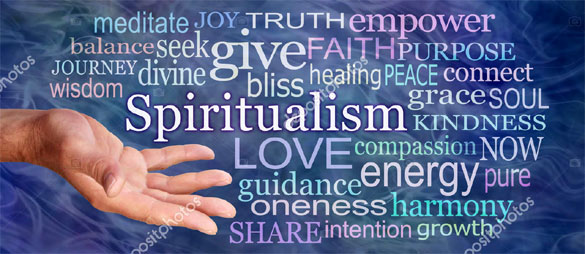
The meaning of Spiritualism Word Cloud - male hand gesturing towards the word SPIRITUALISM surrounded by a word cloud on a blue gaseous ethereal background — Photo by Healing63

-----

Spiritualism and the Holy Quran

The Holy Quran is the torchbearer of the codes of conduct of spiritual life.  The life of the earth is not known. So, life on the earth is not known to anybody except that it has been and has to be full of complexities born out of the changing parameters of the religious, social and political ethos of one’s life. Allah the Creator of the universe is All-Knower so He knew all that is hidden in the future. Islam has been since the inception of the world and will remain till the resurrection of the world on the planet earth. Allah the Almighty during the revelation of the verses on His Apostle Prophet Muhammad Pbuh revealed the codes of life and the solutions of the problems humankind had to face from time to time.

Thus, Science for the social betterment of the society and spiritualism for the social and cultural betterment of the society found mention in the revelations of the Holy Quran. Spiritualism and the ethics of divinity are needed for a blissful life. Following verses from the Holy Quran are bound to be taken as an example of an inclusive, peaceful and rich life, to diminish terrorism.

Quranic Verses with the Lesson of Spirituality

By the ˹passage of˺ time! Surely humanity is i ˹grave˺ loss, except for those who have faith, do good, and urge each other to the truth, and urge each other to perseverance. - (Al-'Asr - 1-3) — Dr. Mustafa Khattab

The above-mentioned verse is a lesson in the management of time. This verse commands human beings to act with wisdom to make this world liveable. The above-mentioned verse also commands to be compassionate and loving for others.

And We will surely test you with something of fear and hunger and a loss of wealth and lives and fruits, but give good tidings to the patient, (al-Baqarah 155) - Sahih International

The Holy Quran asks believers to have patience during times of hardship and difficulties. It also asks the believers to transform the difficult days into an opportunity as hardships make one strong and patient. If the difficult times and hardships of life are taken positively, the experience of life gained from them will act as a reward for the coming days.

Respect and Honour All Human Beings: (Al-Isra: 70)

If You Commit an Error, Then Correct Yourself Immediately: Surah An-Nisa [4:134]

Do Not Be Contemptuous or Arrogant with People - (Luqman: 18)

Be Nice to People (An-Nisa: 36)

To fight the terror menace, Quranic wisdom and spirituality will have to be taught to the people who have followed the wrong path. The spiritual aspect of the Holy Quran and the lessons of brotherhood and inclusivity from the life of Prophet Muhammad Pbuh will have to be included in the madrasa curriculum. Spiritual and educational jihad will win hearts. War only begets war.

The following quote by Stanley Lane-Poole says it all about the Islamic way of teaching even the most brutal enemy.

‘The day of Mohammad's greatest triumph over his enemies was also the day of his grandest victory over himself. He freely forgave the Quraish all the years of sorrow and cruel scorn in which they had afflicted him and gave an amnesty to the whole population of Mecca.” - Stanley Lane-Poole

And Allah Knows the Best.

---

Arman Neyazi is a columnist with NewAgeIslam.com.

URL:  https://www.newageislam.com/spiritual-meditations/spiritualism-terrorism-psychological/d/125300


New Age IslamIslam OnlineIslamic WebsiteAfrican Muslim NewsArab World NewsSouth Asia NewsIndian Muslim NewsWorld Muslim NewsWomen in IslamIslamic FeminismArab WomenWomen In ArabIslamophobia in AmericaMuslim Women in WestIslam Women and Feminism